

Bay Nettle
chrysaora chesapeakei
The Bay Nettle (Chrysaora chesapeakei) is an abundant and ecologically vital species of sea nettle native to the brackish waters of the East Coast of the United States. Famously associated with the Chesapeake Bay, this species was scientifically distinguished from its open-ocean cousin, the Atlantic Sea Nettle, in 2017. As key predators in estuarine ecosystems, they play a crucial role in controlling populations of comb jellies and other zooplankton, which helps protect oyster and fish larvae. Though their venomous sting can be painful to swimmers, these translucent drifters are a fascinating example of estuarine adaptation, thriving in lower-salinity environments where other jellyfish cannot survive.
生息地: Typically found in brackish estuaries, shallow coastal bays, and river mouths along the Atlantic coast of North America.
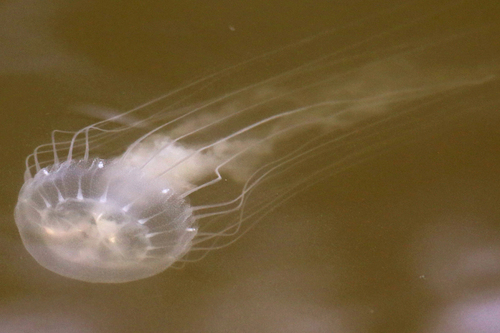
The Bay Nettle features a translucent, saucer-shaped bell that typically ranges from 10 to 20 centimeters in diameter, often marked with distinctive reddish-brown stripes radiating outward from the center like wheel spokes. Extending from the edge of the bell are up to 40 thin, stinging tentacles, accompanied by four long, ribbon-like oral arms that gracefully dangle from the center of the underside. Its coloration ranges from milky white to a delicate pinkish-yellow, making it highly visible as it pulses near the water's surface.
カテゴリ
Animalレア度
Common
危険度
1/5 · 非常に低い
スナップ
最初にスナップしよう!
By feeding on comb jellies that eat oyster larvae, Bay Nettles indirectly help protect and boost the populations of local oysters.
Their bodies are composed of roughly 95% water and they survive without a brain, heart, or bones, relying entirely on a basic nerve net.
Until a DNA sequencing study in 2017, the Bay Nettle was considered the exact same species as the larger, open-ocean Atlantic Sea Nettle.
Deploys specialized stinging cells along its tentacles that mechanically trigger on contact to inject paralyzing venom into prey.
Possesses a highly specialized osmoregulatory system allowing it to thrive in low-salinity estuarine environments.
Capable of rapidly healing and growing back damaged bell tissue and severed tentacles lost to predators or rough wave action.
Mainly feeds on soft-bodied zooplankton, larval fish, and other gelatinous creatures drifted into its path.
年齢による違い: As microscopic polyps, they consume tiny ciliates and rotifers, whereas the adult medusa stage captures much larger prey like comb jellies and small fish.
Mnemiopsis leidyi
Preys heavily upon this abundant comb jelly, preventing it from consuming too many oysters and fish larvae.
Dermochelys coriacea
This large marine reptile is immune to jellyfish stings and actively preys on adult Bay Nettles.
Peprilus paru
Juveniles of this fish species live commensally among the stinging tentacles of the sea nettle for protection from larger predators.
このオブジェクトにはまだ特徴バッジが割り当てられていません。
まだ別名はありません。
テーマが追加されると、このオブジェクトのコレクションがここに表示されます。
危険度
1/5 · 非常に低い
まだ特別な安全上の注意はありません。
Bay Nettleを識別する最も簡単な方法は、Snappit自然識別アプリを使用することです。
5-25 cm
0.05-0.4 kg
最大 1 年
1 km/h
Mainly feeds on soft-bodied zooplankton, larval fish, and other gelatinous creatures drifted into its path.
Typically found in brackish estuaries, shallow coastal bays, and river mouths along the Atlantic coast of North America.
Ambush
ズームインしてクラスターを分割し、このオブジェクトが撮影された場所を探索しましょう。
新しい観察が追加されると、ここに最近のスナップが表示されます。



