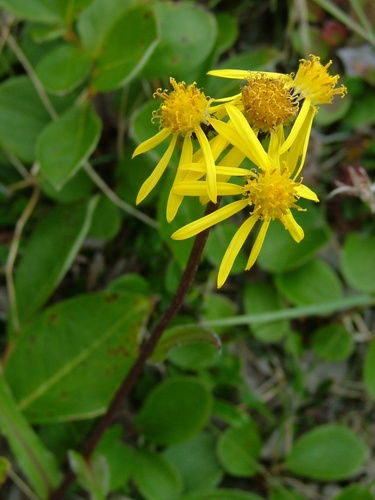


Black-Tip Groundsel
senecio lugens
The Black-Tip Groundsel is an alpine wildflower native to the damp meadows, tundra, and open subalpine forests of western North America. This resilient perennial thrives in cold, high-altitude environments where it puts on a lovely summer display of yellow daisy-like flower heads. Its most distinctive feature is the presence of stark black tips on the leafy bracts surrounding the base of its flower clusters, giving the plant a unique, charred appearance that contrasts beautifully with its bright blooms. Beyond its visual charm, the Black-Tip Groundsel plays an active role in its montane ecosystem, attracting native pollinators and producing chemical compounds that protect it from grazing herbivores. Hikers in northern or mountainous regions often spot this hardy survivor peeking through gravelly slopes and grassy forest clearings.
生息地: Typically found in moist subalpine meadows, alpine tundra, gravelly mountain slopes, and damp openings within coniferous forests.
Growing between 10 to 50 centimeters tall, the Black-Tip Groundsel features a single, erect stem arising from a cluster of thick basal leaves. These leaves are lance-shaped to elliptic, with slightly toothed margins. The flower head cluster consists of several bright yellow, daisy-like blossoms, each showing about 8 to 13 yellow ray petals. The most reliable identifier is the involucral bracts (the small scales directly beneath the flower head), which are green but tipped with a dramatic, prominent black or dark-purple mark, resembling the tip of a freshly burned matchstick.
カテゴリ
植物レア度
Common
危険度
1/5 · 非常に低い
スナップ
最初にスナップしよう!
Because it thrives in high elevations, it is frequently one of the first wildflowers to bloom on mountain passes as the snowpack begins to recede.
The plant's toxic alkaloids are highly selective, deterring deer and sheep but failing to stop specialized caterpillars that use the poison for their own defense.
The scientific species name 'lugens' is Latin for 'mourning', a direct reference to the black-tipped bracts that look like a dark mourning veil.
The characteristic dark, black-tipped bracts help absorb solar radiation in chilly alpine climates, warming the flower head and speeding up seed development.
Produces pyrrolizidine alkaloids throughout its tissues, rendering the plant toxic and highly unpalatable to most mammalian herbivores.
Utilizes a sturdy, fibrous rootstock that can survive deep winter soil freezes and quickly regenerate shoots once the snow melts.
As a photosynthetic autotroph, the Black-Tip Groundsel manufactures its own food using sunlight, water, carbon dioxide, and essential nutrients absorbed from the soil.
Bombus melanopygus
Visits the yellow blossoms for nectar and pollen, acting as a crucial high-altitude pollinator.
Gnophaela vermiculata
Feeds on the foliage of this and other Senecio species, sequestering the plant's toxins for its own defense against predators.
このオブジェクトにはまだ特徴バッジが割り当てられていません。
まだ別名はありません。
テーマが追加されると、このオブジェクトのコレクションがここに表示されます。
危険度
1/5 · 非常に低い
まだ特別な安全上の注意はありません。
Black-Tip Groundselを識別する最も簡単な方法は、Snappit自然識別アプリを使用することです。
10-50 cm
3-10 年
As a photosynthetic autotroph, the Black-Tip Groundsel manufactures its own food using sunlight, water, carbon dioxide, and essential nutrients absorbed from the soil.
Typically found in moist subalpine meadows, alpine tundra, gravelly mountain slopes, and damp openings within coniferous forests.
ズームインしてクラスターを分割し、このオブジェクトが撮影された場所を探索しましょう。
新しい観察が追加されると、ここに最近のスナップが表示されます。















