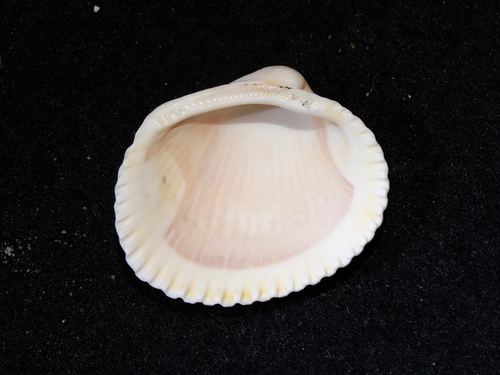


Blood Ark
lunarca ovalis
The Blood Ark (Lunarca ovalis) is a fascinating marine bivalve named for a highly unusual trait: it possesses red blood. Unlike most mollusks, which have clear or bluish, copper-based blood, the Blood Ark utilizes intracellular hemoglobin to transport oxygen. This remarkable adaptation allows the clam to thrive in low-oxygen, murky environments such as muddy bays and estuaries along the western Atlantic coast. Covered in a dark, fibrous coating that makes it resemble a fuzzy stone, this resilient clam is a quiet but vital part of coastal ecosystems, tirelessly filtering the water and serving as a nutrient-rich food source for various marine predators.
生息地: Found in shallow, sandy, or muddy coastal waters and estuaries, typically from the intertidal zone down to a few meters deep.
The Blood Ark features a thick, rounded, somewhat heart-shaped shell that typically grows to about 4 to 6 centimeters in length. Its white shell is heavily sculpted with 26 to 35 prominent, radiating ribs. In life, the shell is largely covered by a thick, dark brown, and distinctly hairy or fibrous outer layer called the periostracum, which often wears away near the hinge to reveal the white shell beneath. When opened or damaged, the clam reveals its striking, bright red, hemoglobin-rich tissues and fluids.
カテゴリ
Invertebrateレア度
Common
危険度
1/5 · 非常に低い
スナップ
最初にスナップしよう!
Because they can survive in oxygen-poor waters, Blood Arks can thrive in muddy, stagnant habitats where many other species of bivalves would suffocate.
The Blood Ark is one of the very few mollusks that bleed red, thanks to the presence of intracellular hemoglobin, functioning much like the blood in vertebrates.
Their scientific genus 'Lunarca' loosely translates to 'moon ark', referring to the clam's rounded, lunar-like shell profile.
Their thick, hairy periostracum often causes beachgoers to mistake them for fuzzy rocks when they are partially buried in the sand.
Unlike most bivalves, it uses iron-based hemoglobin to transport oxygen, allowing it to survive in hypoxic (low-oxygen) mudflats.
A thick, hairy outer shell layer (periostracum) helps the clam blend into muddy substrates and protects the calcium carbonate shell from acidic sediments.
The heavily ribbed shell margins interlock tightly when closed, creating a formidable defense against prying predators like crabs and sea stars.
As a filter feeder, the Blood Ark continuously pumps seawater through its gills to extract suspended microscopic organisms and organic matter.
年齢による違い: Larval stages consume nanoplankton, while adults filter larger microalgae and suspended detritus.
Busycon carica
Knobbed whelks prey upon Blood Arks by using their own shell lip to pry the clam's valves apart.
Larus smithsonianus
Gulls will forage for Blood Arks at low tide, often dropping them from the air onto hard surfaces to crack their thick shells.
Mercenaria mercenaria
Competes for suspended food particles and space in similar muddy estuarine habitats.
このオブジェクトにはまだ特徴バッジが割り当てられていません。
まだ別名はありません。
テーマが追加されると、このオブジェクトのコレクションがここに表示されます。
危険度
1/5 · 非常に低い
まだ特別な安全上の注意はありません。
Blood Arkを識別する最も簡単な方法は、Snappit自然識別アプリを使用することです。
4-6 cm
0.01-0.05 kg
2-5 年
As a filter feeder, the Blood Ark continuously pumps seawater through its gills to extract suspended microscopic organisms and organic matter.
Found in shallow, sandy, or muddy coastal waters and estuaries, typically from the intertidal zone down to a few meters deep.
Filtering
20000-95000
ズームインしてクラスターを分割し、このオブジェクトが撮影された場所を探索しましょう。
新しい観察が追加されると、ここに最近のスナップが表示されます。












