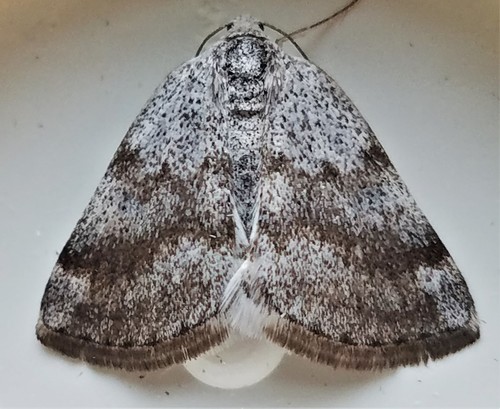


Bluish Spring Moth
lomographa semiclarata
The Bluish Spring Moth (Lomographa semiclarata) is a delicate and charming insect belonging to the Geometridae family. Emerging in the cool days of early spring, this diurnal species is a delightful sight as it flutters gracefully through deciduous woodlands, clearing margins, and riparian corridors. Unlike many of its nocturnal relatives, this moth is frequently active during the daytime, capitalizing on the warming spring sunshine to find mates and navigate the understory. Its presence is highly synchronized with the leafing out of wild cherries and plums, making it a true ecological herald of the changing seasons.
生息地: Found in deciduous forests, mixed woodlands, and brushy fields, particularly near wild cherry and plum thickets.
This small, elegant moth features a wingspan of approximately 1 to 2 centimeters. Its wings are primarily a clean, translucent chalk-white, which exhibits a subtle pearlescent bluish or purplish sheen when caught in direct sunlight. The outer margins of the forewings are lightly dusted with faint greyish-brown scales, and a series of very fine, dark terminal dots typically lines the wing edges. The body is slender and white, and its delicate antennae are short and thread-like, contributing to its fragile appearance.
カテゴリ
昆虫レア度
Common
危険度
1/5 · 非常に低い
スナップ
最初にスナップしよう!
Due to their pure white color and daytime flying habits, they are frequently misidentified by casual observers as small Cabbage White butterflies.
The species name 'semiclarata' roughly translates to 'semi-clear' or 'half-bright,' referencing the delicate, translucent quality of its wings.
They are univoltine, meaning they produce only one generation of adults per year, flying briefly from mid-April to early June.
Active primarily during daylight hours, it relies on solar heat to warm its flight muscles and visually navigate woodland habitats.
The faint bluish, reflective sheen on its white wings helps break up its silhouette against bright, dappled spring sunlight.
Larvae possess highly specialized digestive enzymes allowing them to feed safely on cyanogenic foliage from the rose family.
Larvae feed strictly on the leaves of deciduous trees and shrubs, while adult moths occasionally feed on nectar and water.
年齢による違い: Larvae are leaf-chewing herbivores that consume solid foliage, whereas adults have a vestigial or reduced proboscis used only for sipping liquids like nectar or dew.
Prunus virginiana
Provides critical larval food and egg-laying substrate.
Prunus pensylvanica
Serves as an essential alternate larval host tree.
Poecile atricapillus
Actively preys on both adult moths and caterpillars in the spring.
このオブジェクトにはまだ特徴バッジが割り当てられていません。
まだ別名はありません。
テーマが追加されると、このオブジェクトのコレクションがここに表示されます。
危険度
1/5 · 非常に低い
まだ特別な安全上の注意はありません。
Bluish Spring Mothを識別する最も簡単な方法は、Snappit自然識別アプリを使用することです。
1-2 cm
1-2 cm
0.00005-0.00015 kg
1 年
8 km/h
Larvae feed strictly on the leaves of deciduous trees and shrubs, while adult moths occasionally feed on nectar and water.
Found in deciduous forests, mixed woodlands, and brushy fields, particularly near wild cherry and plum thickets.
ズームインしてクラスターを分割し、このオブジェクトが撮影された場所を探索しましょう。
新しい観察が追加されると、ここに最近のスナップが表示されます。




_Virginia_1.jpg&width=800)







.jpg&width=800)



