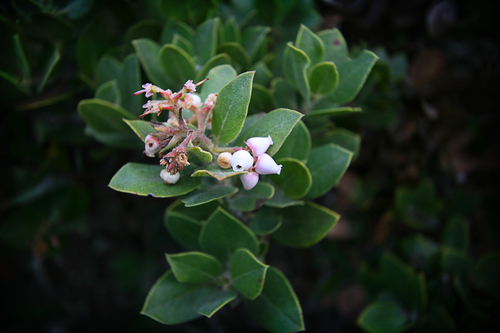


Brittleleaf Manzanita
arctostaphylos crustacea
The Brittleleaf Manzanita is a striking evergreen shrub native to the chaparral and coastal scrub communities of California. Revered for its ecological resilience and handsome architecture, this woody plant features signature deep red-to-mahogany bark that peels away in papery curls. Its tough, leathery leaves and compact growth habit make it extremely well-adapted to Mediterranean climates characterized by dry, hot summers and wet winters. Beyond its aesthetic appeal, it serves as a critical habitat and food resource for local wildlife, while its extensive root system aids in soil stabilization across hilly terrains.
生息地: Found in coastal sage scrub, chaparral, and dry oak woodlands along the California coast, particularly in sandy, nutrient-poor, or rocky soils.
This evergreen shrub typically grows between 1 and 3 meters tall, forming dense mounds or erect, multi-branched structures. It is easily identified by its smooth, deep reddish-brown bark, which naturally peels off in thin, papery sheets. The leaves are ovate to oblong, pale green to olive, and slightly rough or fuzzy to the touch, measuring 2 to 5 centimeters in length. During late winter to early spring, it produces delicate, drooping clusters of urn-shaped flowers that range in color from pure white to soft pink, eventually giving rise to small, round, brownish-red berry-like drupes.
カテゴリ
植物レア度
Common
危険度
1/5 · 非常に低い
スナップ
最初にスナップしよう!
Indigenous California tribes historically harvested the berries to brew a refreshing, cider-like beverage and used the leaves to prepare topical washes.
The common name 'Manzanita' means 'little apple' in Spanish, referring to the visual appearance of the plant's spherical berries.
Unlike many other manzanitas that die completely in a fire and rely only on seed banks to recover, the brittleleaf manzanita can regenerate directly from its charred burl.
Possesses a specialized underground woody lignotuber (burl) that protects vital tissues during wildfires, allowing the shrub to rapidly resprout after above-ground parts are destroyed.
Establishes vital mycorrhizal associations with subsurface fungi, significantly enhancing its ability to absorb water and scarce nutrients in poor soils.
Features thick, leathery leaves covered in a waxy cuticle that drastically reduces water loss via transpiration during dry summer months.
As a photosynthetic plant, the brittleleaf manzanita produces its own food by converting sunlight, carbon dioxide, and water into sugars.
Aphelocoma californica
Feeds on the dry, apple-like drupes and serves as a primary seed disperser for the plant.
Bombus vosnesenskii
Pollinates the hanging, urn-shaped flowers in early spring using buzz pollination.
Tamalia coweni
Induces and lives inside bright reddish galls on the leaf margins, feeding on plant fluids.
このオブジェクトにはまだ特徴バッジが割り当てられていません。
まだ別名はありません。
テーマが追加されると、このオブジェクトのコレクションがここに表示されます。
危険度
1/5 · 非常に低い
まだ特別な安全上の注意はありません。
Brittleleaf Manzanitaを識別する最も簡単な方法は、Snappit自然識別アプリを使用することです。
100-300 cm
30-100 年
As a photosynthetic plant, the brittleleaf manzanita produces its own food by converting sunlight, carbon dioxide, and water into sugars.
Found in coastal sage scrub, chaparral, and dry oak woodlands along the California coast, particularly in sandy, nutrient-poor, or rocky soils.
ズームインしてクラスターを分割し、このオブジェクトが撮影された場所を探索しましょう。
新しい観察が追加されると、ここに最近のスナップが表示されます。




















