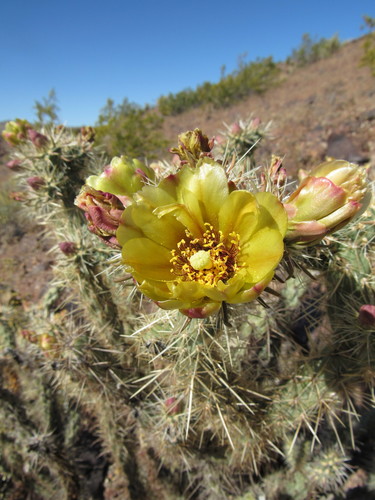


Buckhorn Cholla
cylindropuntia acanthocarpa
The Buckhorn Cholla (Cylindropuntia acanthocarpa) is a prominent, shrubby cactus native to the arid desert regions of the southwestern United States and northwestern Mexico. Characterized by its highly branched, wood-like skeleton and cylindrical, jointed stems, this resilient plant stands as a classic symbol of the Sonoran and Mojave Deserts. It plays an important role in the desert ecosystem, providing nesting sites, protection, and nourishment for various desert-dwelling creatures.
生息地: Found in dry, sandy, or gravelly soils of desert flats, rocky slopes, and bajadas within the Sonoran and Mojave deserts.
Growing between 1 and 4 meters in height, the Buckhorn Cholla displays a sprawling, tree-like structure with a short woody trunk. Its stems are divided into cylindrical green to purplish segments, measuring 10 to 15 centimeters long, which are covered in pronounced tubercles. Each tubercle bears a cluster of 7 to 25 sharp, straw-colored to dark brown spines encased in papery, reflective sheaths. In spring, it produces beautiful, cup-shaped flowers that vary in color from yellow and copper to vibrant red, followed by dry, egg-shaped, exceptionally spiny seed pods.
カテゴリ
植物レア度
Common
危険度
1/5 · 非常に低い
スナップ
最初にスナップしよう!
Indigenous desert peoples, such as the O'odham, traditionally harvested the flower buds of the Buckhorn Cholla in spring, pit-roasting them as a major, calcium-rich food source.
The species name 'acanthocarpa' literally translates to 'thorny fruit' in Greek, referencing the plant's dry, extremely spiny seed pods.
While it looks like a menacing, spiny skeleton after dying, the inner woody trunk of dead chollas is hollow and perforated, often used in desert crafts, walking sticks, and terrariums.
Stems are highly specialized to store large volumes of water, swelling during wet periods and contracting during prolonged droughts to survive hyper-arid conditions.
Spines are covered in thin, papery sheaths that reflect intense desert sunlight, reducing heat absorption and protecting the plant from solar radiation.
Utilizes Crassulacean Acid Metabolism, opening its stomata exclusively at night to capture carbon dioxide, which prevents critical water loss during the scorching day.
As a photosynthetic autotroph, the Buckhorn Cholla produces its own organic nutrients from sunlight, carbon dioxide, water, and soil minerals.
Campylorhynchus brunneicapillus
Provides critical nesting sites protected from predators by dense, sharp spines.
Gopherus agassizii
Feeds on the moisture-rich flowers, fruits, and younger segments of the plant during dry periods.
Dactylopius coccus
Infests the stems, sucking the plant's juices while creating a cottony, white protective cover.
このオブジェクトにはまだ特徴バッジが割り当てられていません。
まだ別名はありません。
テーマが追加されると、このオブジェクトのコレクションがここに表示されます。
危険度
1/5 · 非常に低い
まだ特別な安全上の注意はありません。
Buckhorn Chollaを識別する最も簡単な方法は、Snappit自然識別アプリを使用することです。
100-400 cm
30-150 年
As a photosynthetic autotroph, the Buckhorn Cholla produces its own organic nutrients from sunlight, carbon dioxide, water, and soil minerals.
Found in dry, sandy, or gravelly soils of desert flats, rocky slopes, and bajadas within the Sonoran and Mojave deserts.
ズームインしてクラスターを分割し、このオブジェクトが撮影された場所を探索しましょう。
新しい観察が追加されると、ここに最近のスナップが表示されます。













.jpg&width=800)