

Bush Morning-Glory
ipomoea leptophylla
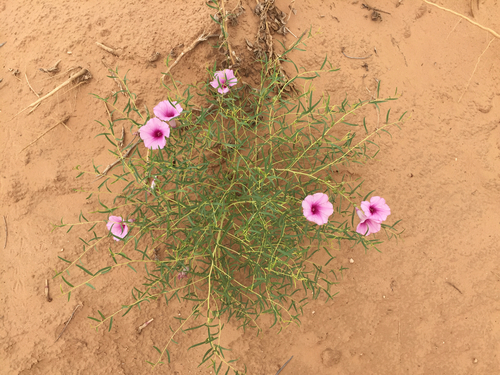
The Bush Morning-Glory (Ipomoea leptophylla) is a remarkable perennial wildflower native to the dry prairies and plains of central North America. Unlike its sprawling, vine-like relatives, this species grows as an erect, bushy herb with a highly resilient structure. It is famous for its extraordinarily massive, deep taproot, which can weigh up to 45 kilograms (100 pounds) and serves as a vital underground water reservoir, allowing the plant to thrive in arid conditions where other vegetation withers. During the summer, it paints the sandy landscape with brilliant pink-purple blossoms. Its deep root system also acts as an ecological anchor, stabilizing loose soils in wind-swept environments.
生息地: Found in dry, sandy or gravelly prairies, plains, and hillsides across the North American Great Plains.
This plant grows as an upright, bushy clump reaching heights of 30 to 120 cm. It has numerous slender, smooth, pale branches that support narrow, linear, green leaves measuring 5 to 15 cm long. The flowers are showy, funnel-shaped, and pink-purple to magenta in color, measuring 5 to 8 cm across with a distinctly darker purple throat. Following pollination, it produces pointed, dry capsules containing hairy, dark brown seeds.
カテゴリ
植物レア度
Common
危険度
1/5 · 非常に低い
スナップ
最初にスナップしよう!
Early Native American tribes, including the Lakota, historically used the large roots for medicinal purposes and occasionally as an emergency food source after long roasting times.
Its massive tuberous root can grow to the size of a human torso, allowing it to store enough water to survive years of extreme drought.
Unlike most morning-glories which are vines requiring support to climb, the Bush Morning-Glory is a self-supporting woody shrub.
Possesses an incredibly large, deep, tuberous taproot that can weigh over 45 kg, storing immense amounts of water and nutrients to survive extreme droughts.
Its extensive and powerful root system helps bind loose, sandy soils, making it highly effective at preventing soil erosion in arid wind-swept landscapes.
Narrow, linear leaves minimize surface area, significantly reducing water loss through transpiration in hot, dry environments.
As a photoautotroph, it manufactures its own organic compounds from sunlight, water, and carbon dioxide through the process of photosynthesis.
Bombus bimaculatus
Pollinated by bumblebees and other native bees seeking nectar and pollen.
Chaetocnema confinis
Leaves and stems are consumed by beetles specialized in Convolvulaceae plants.
このオブジェクトにはまだ特徴バッジが割り当てられていません。
まだ別名はありません。
テーマが追加されると、このオブジェクトのコレクションがここに表示されます。
危険度
1/5 · 非常に低い
まだ特別な安全上の注意はありません。
Bush Morning-Gloryを識別する最も簡単な方法は、Snappit自然識別アプリを使用することです。
30-120 cm
5-50 kg
10-50 年
As a photoautotroph, it manufactures its own organic compounds from sunlight, water, and carbon dioxide through the process of photosynthesis.
Found in dry, sandy or gravelly prairies, plains, and hillsides across the North American Great Plains.
ズームインしてクラスターを分割し、このオブジェクトが撮影された場所を探索しましょう。
新しい観察が追加されると、ここに最近のスナップが表示されます。