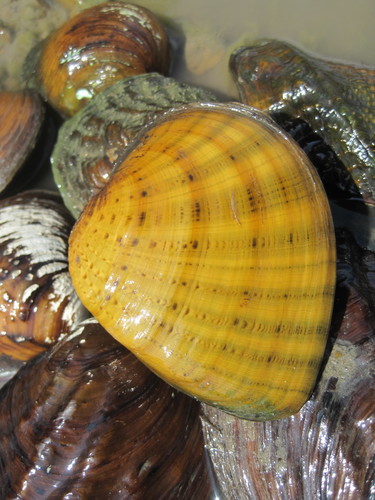


Butterfly Mussel
ellipsaria lineolata
The Butterfly Mussel (Ellipsaria lineolata) is a captivating freshwater bivalve renowned for its unique shell morphology and an astonishing reproductive strategy. Its common name aptly describes the distinctive, wing-like expansions on the posterior margin of its shell, giving it a delicate, butterfly-like appearance. This species is a vital component of healthy river ecosystems, acting as a natural water filter that enhances clarity and supports diverse aquatic life. Its most fascinating characteristic is the elaborate mantle lure displayed by females, which masterfully mimics a small fish, crucial for attracting specific host fish for its parasitic larval stage, showcasing a remarkable example of co-evolution.
生息地: Found in medium to large rivers and streams, typically embedded in stable substrates of sand, gravel, or mixed cobble in moderate to swift currents.
The shell of the Butterfly Mussel is elongated and somewhat compressed, typically reaching lengths of 5 to 12 centimeters. It is easily recognized by its prominent, flared posterior 'wings' that give it an almost triangular or rectangular profile when viewed dorsally. The shell's exterior is generally smooth, exhibiting a yellowish to light brown coloration, often adorned with dark green or black zigzag patterns or distinct rays, particularly in younger individuals. The inner surface of the shell, or nacre, is a pristine white. Female mussels exhibit a highly specialized mantle tissue that extends beyond the shell margin, forming a convincing mimicry of a small fish, complete with fake 'eyes' and 'fins'.
カテゴリ
Invertebrateレア度
Common
危険度
1/5 · 非常に低い
スナップ
最初にスナップしよう!
As powerful filter feeders, a single Butterfly Mussel can filter many gallons of water per day, playing a vital role in keeping freshwater ecosystems clean and healthy.
Each female mussel can release tens of thousands of microscopic glochidia larvae, which dramatically increases the chances of successful attachment to a host fish.
The female Butterfly Mussel's mantle lure is so realistic it can even fool human observers into believing it's a small fish swimming near the mussel's shell.
The species name "lineolata" is Latin for 'marked with fine lines', referring to the delicate ray patterns often visible on its shell.
Female Butterfly Mussels possess a highly specialized mantle lure, which they actively display outside their shell. This lure strikingly mimics a small fish or crayfish, complete with 'eyes' and 'fins', to attract unsuspecting host fish.
As a sessile bivalve, the mussel constantly siphons large volumes of water, filtering out microscopic organic particles. This process significantly contributes to water purification and nutrient cycling in its aquatic environment.
Its microscopic larvae, known as glochidia, are obligate parasites that attach to the gills or fins of specific fish species. This crucial parasitic stage allows for the dispersal and maturation of the young mussels before they detach and settle as free-living juveniles.
The Butterfly Mussel is a sedentary filter feeder, drawing water into its siphons and straining out microscopic organic particles suspended in the water column. Its diet consists primarily of a variety of small organisms and decaying matter.
Micropterus salmoides
Serves as an essential host for the mussel's parasitic larvae (glochidia), allowing for their dispersal and development.
various species
A primary food source, these microscopic aquatic plants are filtered from the water column by the mussel.
Lontra canadensis
These semi-aquatic mammals are predators that can consume freshwater mussels, including the Butterfly Mussel.
Homo sapiens
Human activities leading to habitat degradation and pollution severely impact mussel populations and their ability to thrive.
このオブジェクトにはまだ特徴バッジが割り当てられていません。
まだ別名はありません。
テーマが追加されると、このオブジェクトのコレクションがここに表示されます。
危険度
1/5 · 非常に低い
まだ特別な安全上の注意はありません。
Butterfly Musselを識別する最も簡単な方法は、Snappit自然識別アプリを使用することです。
5-12 cm
0.05-0.3 kg
10-30 年
The Butterfly Mussel is a sedentary filter feeder, drawing water into its siphons and straining out microscopic organic particles suspended in the water column. Its diet consists primarily of a variety of small organisms and decaying matter.
Found in medium to large rivers and streams, typically embedded in stable substrates of sand, gravel, or mixed cobble in moderate to swift currents.
Filtering
10000-100000
ズームインしてクラスターを分割し、このオブジェクトが撮影された場所を探索しましょう。
新しい観察が追加されると、ここに最近のスナップが表示されます。




_-_Ficidae_-_Mollusc_shell.jpeg&width=800)




.jpg&width=800)
