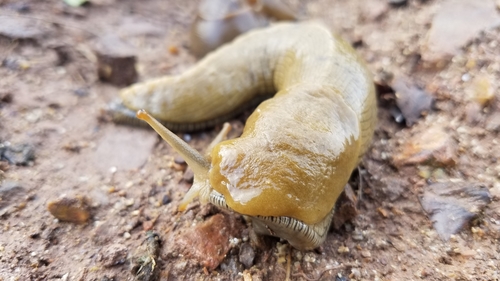


Button'S Banana Slug
ariolimax buttoni
Button's Banana Slug (Ariolimax buttoni) is a fascinating and iconic terrestrial mollusk native to the moist, coastal forests of California. Known for their striking, banana-like appearance, these slow-moving invertebrates play a crucial role as nature's recyclers. As dedicated detritivores, they tirelessly comb the forest floor for decaying organic matter, fungi, and animal droppings, transforming waste into nutrient-rich soil that sustains giant redwood ecosystems. Watching a Button's Banana Slug glide gracefully across a mossy log is a testament to the quiet, hidden machinery of the forest. They are beloved symbols of the Pacific coast's damp, old-growth woodlands, capturing the curiosity of hikers and naturalists alike with their vibrant coloration and vital ecological contributions.
生息地: Found in moist coastal redwood forests, often residing among damp leaf litter, ferns, and decaying logs.
This large, fleshy slug is instantly recognizable by its vibrant, mustard-yellow to greenish-yellow coloration, which strongly resembles a ripe banana. Some individuals feature dark brown or black spots scattered across their bodies, making them look like overripe bananas. Measuring between 10 to 25 centimeters in length, they possess a prominent saddle-shaped mantle behind their head, which houses a single breathing hole called a pneumostome on the right side. Their head features two pairs of retractable tentacles: a longer upper pair tipped with eye spots for sensing light, and a shorter lower pair used for feeling and tasting their immediate environment.
カテゴリ
Invertebrateレア度
Common
危険度
1/5 · 非常に低い
スナップ
最初にスナップしよう!
Banana slugs are the second-largest species of terrestrial slug in the world, surpassed only by the Limax cinereoniger of Europe.
Their slime is so unique that researchers have studied it to develop surgical glues and medical adhesives because of its powerful binding properties in wet environments.
They breathe through a single hole on the right side of their mantle called a pneumostome, which they can purposefully open and close to prevent moisture loss.
They have an incredible ability to consume mushrooms that are highly toxic to humans, acting as vital spore-spreaders for the forest's fungal network.
When threatened, they secrete a specialized, thick mucus that contains a mild anesthetic to numb the mouths and tongues of potential predators.
Their slime not only helps them glide over rough terrain but also absorbs water from the environment, protecting them from fatal dehydration during dry spells.
They possess both male and female reproductive organs, allowing any two mature slugs to mate and lay viable eggs, which maximizes their reproductive success.
They are essential forest scavengers, feeding primarily on decaying plant matter, fungi, and animal droppings.
年齢による違い: Juveniles eat softer, more easily digestible fungi and tender shoots before transitioning to a broader, coarser detritus diet as adults.
Dicamptodon tenebrosus
One of the few predators capable of eating adult banana slugs despite their sticky, numbing slime.
Thamnophis sirtalis
Garter snakes will sometimes prey on juvenile banana slugs that are smaller and easier to swallow.
Amanita muscaria
Banana slugs consume various fungi, including toxic species like the Fly Agaric, without ill effects, spreading their spores throughout the forest.
Oxalis oregana
The slug frequently forages among and feeds on the decaying leaves of this common forest floor plant.
このオブジェクトにはまだ特徴バッジが割り当てられていません。
まだ別名はありません。
テーマが追加されると、このオブジェクトのコレクションがここに表示されます。
危険度
1/5 · 非常に低い
まだ特別な安全上の注意はありません。
Button'S Banana Slugを識別する最も簡単な方法は、Snappit自然識別アプリを使用することです。
10-25 cm
0.05-0.11 kg
1-7 年
They are essential forest scavengers, feeding primarily on decaying plant matter, fungi, and animal droppings.
Found in moist coastal redwood forests, often residing among damp leaf litter, ferns, and decaying logs.
Foraging
20-30
ズームインしてクラスターを分割し、このオブジェクトが撮影された場所を探索しましょう。
新しい観察が追加されると、ここに最近のスナップが表示されます。

California, US
ここで見られるかも Redwood Sorrel, レッドウッド と Button's Banana Slug.
ガイドを見る →

California, US
ここで見られるかも Hilton's Aeolid, Opalescent Nudibranch と シマヒライソガニ.
ガイドを見る →

California, US
ここで見られるかも ダグラスジリス, Button's Banana Slug と ニリンソウ.
ガイドを見る →

US
ここで見られるかも Button's Banana Slug, Ochre Sea Star と Bat Star.
ガイドを見る →

California, US
ここで見られるかも エルク, キタゾウアザラシ と Button's Banana Slug.
ガイドを見る →

California, US
ここで見られるかも アオジャコウアゲハ, ニシカキネトカゲ と ファイアリーセセリチョウ.
ガイドを見る →














_(14534156278).jpg&width=800)



