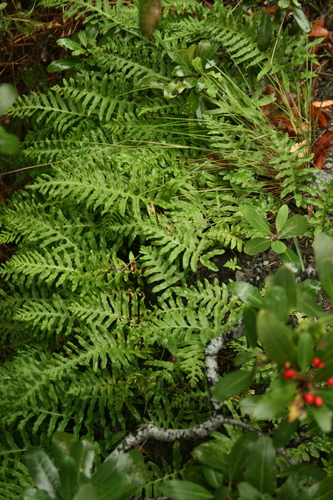


California Polypody
polypodium californicum
The California Polypody (Polypodium californicum) is a delightful native fern that adds vibrant greenery to the coastal forests and canyons of California and Baja California. Thriving in the cool, moist winters of the Mediterranean climate, this resilient plant often grows as an epiphyte on trees or clings tightly to rocky cliffs and mossy banks. Unlike many other ferns, it has adapted to dry summers by entering a dormant state, dryly curling up only to spring back to life with the first autumn rains. This cyclical behavior makes it a fascinating indicator of seasonal change along the Pacific coast.
生息地: Found in moist coastal canyons, shady woodlands, and rocky cliffs, often growing on moss-covered trees or damp rock faces.
This medium-sized fern features deeply lobed, lance-shaped fronds that range from 10 to 70 centimeters in length. The segments of the fronds are oblong, slightly tooth-edged, and display a vibrant green to yellow-green color. On the undersides of mature leaves, look for double rows of round, orange-to-yellow spore cases (sori) without a protective cover (indusium), which is a key identifying trait of the polypody genus. Its creeping, fleshy rhizomes are often visible, carpeted in moss or clinging tightly to bark or rock surfaces.
カテゴリ
植物レア度
Common
危険度
1/5 · 非常に低い
スナップ
最初にスナップしよう!
Indigenous peoples, including the Costanoan, used the sweet-tasting rhizomes of the California polypody to treat sore throats and coughs.
The name 'Polypodium' translates from Greek to 'many-footed,' referencing the many foot-like branches of its creeping rhizome system.
This plant is winter-deciduous, meaning it sheds its leaves in summer to survive dry droughts and grows brand new fronds during the wet winter months.
It survives intense drought by drying out and dropping its fronds in summer, instantly reviving when winter rains return.
Creeping rhizomes allow it to anchor securely and extract nutrients from mossy tree bark and rock crevices.
Naked sori (spore clusters) facilitate rapid, unobstructed wind-dispersal of spores when conditions are moist.
As a photoautotrophic plant, it produces its own energy using sunlight, water, and carbon dioxide through photosynthesis.
Sequoia sempervirens
Provides shade and microclimatic conditions; the fern often grows epiphytically on its trunks.
Ariolimax columbianus
Feeds on the damp fronds of the fern during the rainy winter season.
Acer macrophyllum
Serves as an epiphytic host with mossy bark that supports the creeping rhizomes of the fern.
このオブジェクトにはまだ特徴バッジが割り当てられていません。
まだ別名はありません。
テーマが追加されると、このオブジェクトのコレクションがここに表示されます。
危険度
1/5 · 非常に低い
まだ特別な安全上の注意はありません。
California Polypodyを識別する最も簡単な方法は、Snappit自然識別アプリを使用することです。
10-70 cm
5-20 年
As a photoautotrophic plant, it produces its own energy using sunlight, water, and carbon dioxide through photosynthesis.
Found in moist coastal canyons, shady woodlands, and rocky cliffs, often growing on moss-covered trees or damp rock faces.
ズームインしてクラスターを分割し、このオブジェクトが撮影された場所を探索しましょう。
新しい観察が追加されると、ここに最近のスナップが表示されます。















