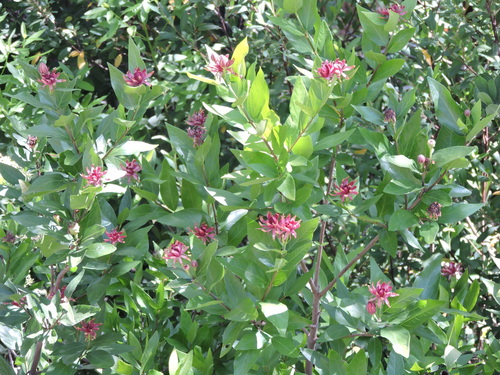


California Sweetshrub
calycanthus occidentalis
The California Sweetshrub, also known as Western Spicebush, is a striking deciduous shrub endemic to the moist riparian zones, canyons, and foothill woodlands of California and southwestern Oregon. Belonging to an ancient lineage of flowering plants, this species is highly celebrated for its exceptional aromatic qualities; virtually every part of the shrub, including the bark, leaves, and twigs, releases a rich, spicy scent reminiscent of cinnamon, red wine, or fermenting peaches when bruised. Aside from its sensory charm, the California Sweetshrub plays a vital ecological role by stabilizing stream banks and providing excellent nesting cover and shelter for local wildlife. Its lush foliage and dramatic, deep red blossoms make it a highly desirable choice for native plant gardeners looking to add ecological value and natural beauty to shaded landscapes.
生息地: Typically found in moist, rich soils along streams, riverbanks, and in shaded canyons within foothill woodlands.
This erect, multi-stemmed shrub typically reaches heights of 100 to 400 centimeters, displaying glossy, bright green, ovate leaves arranged oppositely along its branches. In late spring and summer, it showcases solitary, terminal flowers that are 5 to 8 centimeters wide. These unique, lotus-like blossoms lack distinct petals and sepals, instead featuring numerous spirally arranged, ribbon-like tepals of a deep maroon, brownish-red, or copper color. Following pollination, the flowers mature into distinctive, urn-shaped seed capsules that turn brownish-gray and persist on the bare winter branches.
カテゴリ
植物レア度
Common
危険度
1/5 · 非常に低い
スナップ
最初にスナップしよう!
Indigenous peoples of California traditionally used the bark of the California Sweetshrub to treat respiratory ailments and sore throats.
Its maroon, lotus-like flowers are evolutionarily primitive and do not have true, separate petals and sepals, but rather a spiraling series of intermediate structures called tepals.
The dried wood retains its spicy scent for years and was historically used by early settlers as a natural wardrobe freshener and insect repellent.
Produces highly aromatic essential oils throughout its tissues that act as a natural deterrent against many generalist herbivores.
Emits a strong, fruity aroma from its flowers specifically designed to mimic fermenting fruit, attracting sap beetles for pollination.
Possesses highly flexible stems and a tenacious, deep root system that allow it to withstand seasonal flooding and rapid water currents.
As a photoautotrophic plant, it manufactures its own organic compounds from sunlight, water, and carbon dioxide through the process of photosynthesis.
Carpophilus hemipterus
Sap beetles pollinate the flowers while feeding on specialized, protein-rich food bodies located on the inner tepals.
Odocoileus hemionus
Deer occasionally browse the tender leaves and twigs, though the strong aromatic oils limit heavy feeding.
Castor canadensis
Beavers sometimes use the strong, flexible branches for lodge construction and chew on the bark during winter.
このオブジェクトにはまだ特徴バッジが割り当てられていません。
まだ別名はありません。
テーマが追加されると、このオブジェクトのコレクションがここに表示されます。
危険度
1/5 · 非常に低い
まだ特別な安全上の注意はありません。
California Sweetshrubを識別する最も簡単な方法は、Snappit自然識別アプリを使用することです。
100-400 cm
20-50 年
As a photoautotrophic plant, it manufactures its own organic compounds from sunlight, water, and carbon dioxide through the process of photosynthesis.
Typically found in moist, rich soils along streams, riverbanks, and in shaded canyons within foothill woodlands.
ズームインしてクラスターを分割し、このオブジェクトが撮影された場所を探索しましょう。
新しい観察が追加されると、ここに最近のスナップが表示されます。









_Teucrium_fruticans_-_Flowers.jpg&width=800)