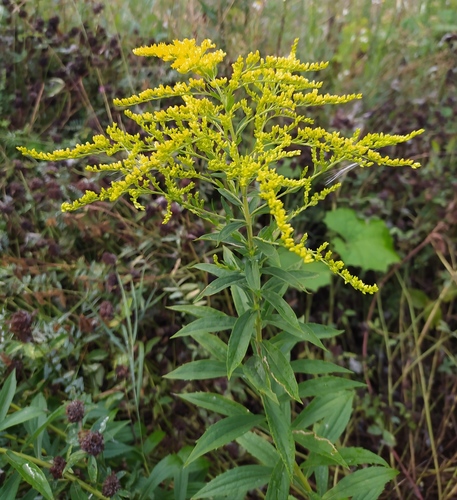


Canada Goldenrod
solidago canadensis
Canada Goldenrod (Solidago canadensis) is a vigorous, herbaceous perennial wildflower native to North America. Famous for its brilliant, feathery plumes of yellow flowers that paint fields and roadsides in late summer and autumn, this plant is an ecological powerhouse. It plays a crucial role in supporting late-season pollinators, providing a vital source of nectar and pollen when other flowers have finished blooming. Despite its beauty and ecological value, it is sometimes misunderstood as a cause of hay fever, a misconception actually caused by wind-pollinated ragweed which blooms at the exact same time.
生息地: Typically found in open areas such as old fields, meadows, prairies, roadsides, disturbed areas, and forest edges.
This plant typically stands between 30 and 200 centimeters tall, featuring central stems that are woody at the base and covered in fine hairs. Its leaves are alternate, lance-shaped, sharply serrated along the margins, and have three prominent parallel veins running from the base. The most striking feature is the large, pyramid-shaped terminal cluster composed of hundreds of tiny, bright-yellow flower heads that curve outwards and upwards, creating a feathery, golden-spray appearance.
カテゴリ
植物レア度
Common
危険度
1/5 · 非常に低い
スナップ
最初にスナップしよう!
Despite being widely blamed for seasonal allergies, goldenrod pollen is heavy and sticky, designed for insect pollination rather than wind transport; the real culprit is ragweed.
In Europe and parts of Asia, Canada Goldenrod is classified as an aggressive invasive species that outcompetes native vegetation.
Thomas Edison experimented with Canada Goldenrod to produce rubber from its latex-rich leaves, even breeding a giant variant to maximize yield.
It spreads rapidly underground via aggressive creeping rhizomes, allowing a single plant to form large, dense clonal colonies that outcompete other flora.
The plant releases chemical compounds from its roots into the soil that inhibit the germination and growth of neighboring plant species.
It times its heavy blooming period to late summer and early autumn, capitalizing on a lack of competing floral resources to attract diverse pollinators.
As a photoautotrophic plant, Canada Goldenrod produces its own energy through photosynthesis, utilizing sunlight, carbon dioxide, and water.
年齢による違い: Seedlings rely on seed energy reserves until they develop true leaves, after which they depend entirely on photosynthesis.
Eurosta solidaginis
The Goldenrod Gall Fly larvae induce the plant to form spherical stem galls where the larvae overwinter and feed.
Apis mellifera
European Honeybees actively forage on the abundant nectar and pollen of the late-summer blooms.
Odocoileus virginianus
White-tailed Deer occasionally graze on the young, tender leaves of the goldenrod in the spring.
このオブジェクトにはまだ特徴バッジが割り当てられていません。
まだ別名はありません。
テーマが追加されると、このオブジェクトのコレクションがここに表示されます。
危険度
1/5 · 非常に低い
まだ特別な安全上の注意はありません。
Canada Goldenrodを識別する最も簡単な方法は、Snappit自然識別アプリを使用することです。
30-200 cm
0.02-0.4 kg
3-10 年
As a photoautotrophic plant, Canada Goldenrod produces its own energy through photosynthesis, utilizing sunlight, carbon dioxide, and water.
Typically found in open areas such as old fields, meadows, prairies, roadsides, disturbed areas, and forest edges.
Photosynthesis
ズームインしてクラスターを分割し、このオブジェクトが撮影された場所を探索しましょう。
新しい観察が追加されると、ここに最近のスナップが表示されます。


















