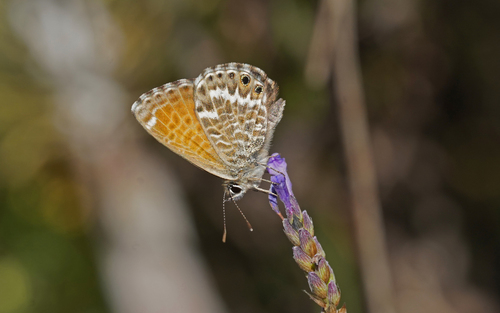


Canary Blue
cyclyrius webbianus
The Canary Blue (Cyclyrius webbianus) is a charming and distinctive butterfly endemic to the Canary Islands, known for the striking azure iridescence of its males. This small lycaenid butterfly is a familiar sight across various habitats on the archipelago, fluttering among flowering plants and rocky outcrops. It embodies the unique biodiversity of the Canary Islands, being one of several species found nowhere else on Earth. Its life cycle is intricately linked with specific Lotus species, offering a fascinating glimpse into the co-evolutionary relationships between insects and their host plants. Observing the Canary Blue provides a delightful connection to the island's natural heritage, showcasing a delicate beauty adapted to its volcanic home.
生息地: This species is commonly found in a variety of open, sunny habitats across the Canary Islands, including rocky slopes, ravines, scrubland, and the edges of laurel forests, particularly where its host plants thrive.
The male Canary Blue is easily identified by its brilliant, iridescent blue upperwings, often framed by a narrow black margin. Females are typically duller, exhibiting a brown coloration on their upperwings, sometimes with a dusting of blue scales near the wing bases. The undersides of both sexes are a more subdued greyish-brown, marked with small, inconspicuous black spots and often a faint, wavy white line near the wing margins. It is a relatively small butterfly, with a wingspan ranging from approximately 2.5 to 3.5 centimeters.
カテゴリ
昆虫レア度
Common
危険度
1/5 · 非常に低い
スナップ
最初にスナップしよう!
Despite its name "Canary Blue," it is not found on all Canary Islands, with its distribution being somewhat patchy across the archipelago.
Like many Lycaenidae butterflies, the larvae of the Canary Blue may have symbiotic relationships with ants, which protect them from predators in exchange for sugary secretions.
The adult butterflies are often seen "basking" in the sun with their wings open, a behavior that helps them regulate their body temperature for flight.
The vivid blue color of the male's wings is not due to pigment but rather to structural coloration, where microscopic structures on the scales scatter light to create the iridescent effect.
The larvae of the Canary Blue are highly specialized feeders, relying exclusively on certain Lotus species found in the Canary Islands. This specificity ensures their nutritional needs are met but also links their survival directly to the health and presence of these plants.
The brilliant blue of the male's upperwings might seem conspicuous, but when at rest with wings folded, the duller, mottled grey-brown undersides provide excellent camouflage against rocks and dry vegetation. This allows them to blend into their environment, evading predators.
The Canary Blue is multivoltine, meaning it produces multiple generations throughout the year, especially in favorable conditions. This adaptation allows it to maximize reproductive output and survive across different seasons, taking advantage of prolonged warm periods.
Adult Canary Blues primarily feed on nectar from various flowering plants, providing them with energy. Their larvae, however, are herbivorous, exclusively consuming the leaves and young shoots of specific Lotus species, which are critical for their development.
年齢による違い: Yes, larvae feed on specific host plant leaves, while adults primarily feed on flower nectar.
Lotus campylocladus
Larval host plant
Lotus sessilifolius
Larval host plant
Gallotia spp.
Common predator
Merops apiaster
Generalist predator
このオブジェクトにはまだ特徴バッジが割り当てられていません。
まだ別名はありません。
テーマが追加されると、このオブジェクトのコレクションがここに表示されます。
危険度
1/5 · 非常に低い
まだ特別な安全上の注意はありません。
Canary Blueを識別する最も簡単な方法は、Snappit自然識別アプリを使用することです。
1-2 cm
2-3 cm
0.0001-0.0003 kg
0-1 年
10 km/h
Adult Canary Blues primarily feed on nectar from various flowering plants, providing them with energy. Their larvae, however, are herbivorous, exclusively consuming the leaves and young shoots of specific Lotus species, which are critical for their development.
This species is commonly found in a variety of open, sunny habitats across the Canary Islands, including rocky slopes, ravines, scrubland, and the edges of laurel forests, particularly where its host plants thrive.
ズームインしてクラスターを分割し、このオブジェクトが撮影された場所を探索しましょう。
新しい観察が追加されると、ここに最近のスナップが表示されます。




_mating_2.jpg&width=800)









_(8-7-08)_blanco_river%2C_co_(1)_(9424551044).jpg&width=800)

