

Cape Smilax
asparagus asparagoides
Cape Smilax, also known as bridal creeper or bridal veil creeper, is an elegant climbing perennial vine native to southern Africa. Despite its delicate appearance, with glossy, leaf-like cladodes and dainty white flowers, it is an incredibly robust and aggressive invader in ecosystems outside its native range, particularly in Australia and New Zealand. It climbs up surrounding vegetation, forming dense, heavy blankets of foliage that can smother native understory plants and prevent light penetration. Underneath the soil, it builds a massive, interlocking mat of tuberous roots that store water and nutrients, allowing it to survive harsh summers and outcompete other flora for valuable resources. Historically introduced as a decorative floral plant, it is now recognized as a severe ecological threat in many Mediterranean-climate regions.
生息地: Found in coastal woodlands, dry sclerophyll forests, riparian zones, and disturbed urban green spaces, often climbing over shrubs and trees.
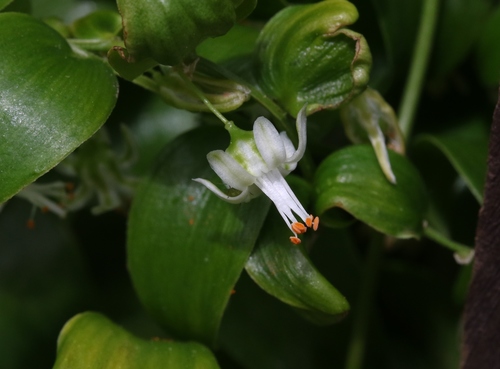
Cape Smilax is characterized by its slender, twining stems that can reach up to three meters in length. It possesses shiny, bright green, heart-shaped structures called cladodes, which function as leaves and are arranged alternately along the stems. During winter and early spring, it produces small, solitary white to greenish-white flowers with six petals, which emit a sweet fragrance. These blossoms develop into small, round, fleshy berries that transition from green to a striking sticky red when mature. Below ground, the plant features a complex, dense root network comprising numerous white, fleshy tubers radiating from a central rhizome.
カテゴリ
植物レア度
Common
危険度
1/5 · 非常に低い
スナップ
最初にスナップしよう!
A single mature Cape Smilax plant can produce over one thousand berries per square meter, making its spread by birds incredibly rapid.
Despite its common name Cape Smilax, this plant is actually a member of the asparagus family (Asparagaceae), not the true Smilax family.
Its underground root and tuber network can account for up to nine-tenths of the plant's total biomass, making it extremely difficult to eradicate by hand weeding.
The plant develops a dense underground network of fleshy tubers that store water and nutrients, enabling it to survive drought and regenerate rapidly.
Its climbing, twining stems quickly scale native vegetation to form a thick, canopy-blocking mat that deprives underlying plants of essential sunlight.
It produces sweet, brightly colored red berries that are highly attractive to birds, ensuring rapid and widespread distribution of its seeds.
As a photosynthetic plant, Cape Smilax generates its own energy by utilizing sunlight, water, and carbon dioxide, while absorbing essential minerals through its extensive root system.
Zygina sp.
The biological control agent Zygina sp. feeds specifically on the leaves of Cape Smilax, causing severe damage and reducing vine vigor.
Puccinia myrsiphylli
The rust fungus Puccinia myrsiphylli attacks the leaves and stems of Cape Smilax, leading to defoliation and a reduction in tuber production.
Zosterops lateralis
The Silvereye bird actively consumes the ripe red berries of the vine, subsequently dispersing the seeds in its droppings.
このオブジェクトにはまだ特徴バッジが割り当てられていません。
まだ別名はありません。
テーマが追加されると、このオブジェクトのコレクションがここに表示されます。
危険度
1/5 · 非常に低い
まだ特別な安全上の注意はありません。
Cape Smilaxを識別する最も簡単な方法は、Snappit自然識別アプリを使用することです。
100-300 cm
5-20 年
As a photosynthetic plant, Cape Smilax generates its own energy by utilizing sunlight, water, and carbon dioxide, while absorbing essential minerals through its extensive root system.
Found in coastal woodlands, dry sclerophyll forests, riparian zones, and disturbed urban green spaces, often climbing over shrubs and trees.
ズームインしてクラスターを分割し、このオブジェクトが撮影された場所を探索しましょう。
新しい観察が追加されると、ここに最近のスナップが表示されます。















