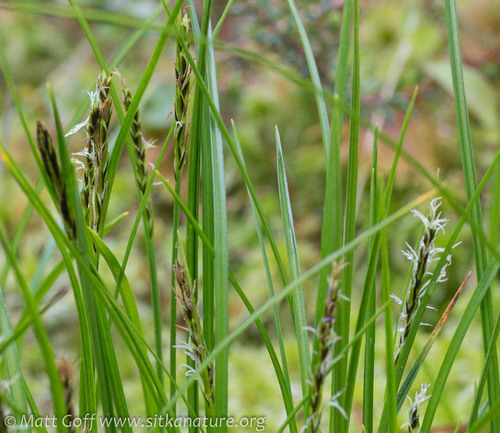


Carex Pauciflora Clade
carex pauciflora
Carex pauciflora, commonly known as the Few-flowered Sedge, is a fascinating member of the diverse Cyperaceae family, often found thriving in the challenging conditions of northern bogs and wet heaths. This unassuming plant, despite its delicate appearance, is a resilient perennial, perfectly adapted to acidic and nutrient-poor environments. Its presence is a key indicator of specific wetland ecosystems, contributing to the unique biodiversity of these areas. It forms an integral part of the understory vegetation, providing structure and contributing to the overall ecological stability of its cold, damp habitats.
生息地: This sedge is typically found in ombrotrophic and minerotrophic bogs, acidic fens, wet heathlands, and damp coniferous forests, often growing among sphagnum mosses.
The Few-flowered Sedge is characterized by its slender, erect stems, typically growing between 10 to 30 centimeters tall. Its leaves are very narrow, almost hair-like, and grooved, emerging from the base. The most distinctive feature is its sparse inflorescence, which consists of a single, small, reddish-brown spikelet at the top of the stem, bearing only a few flowers (hence 'pauciflora'). The perigynia, which enclose the achenes (seeds), are distinctively narrow and often reflexed downwards as they mature, giving the spikelet a somewhat bristly appearance.
カテゴリ
植物レア度
Common
危険度
1/5 · 非常に低い
スナップ
最初にスナップしよう!
Despite its delicate appearance, Carex pauciflora is highly cold-hardy and can tolerate deep frosts common in its northern range.
It is a key indicator species for ombrotrophic bogs, which are wetlands that receive all their water and nutrients from precipitation, making them extremely acidic and nutrient-poor.
Like many sedges, its stems are typically triangular in cross-section, a characteristic that helps distinguish sedges from grasses.
The name 'pauciflora' is Latin for 'few-flowered', accurately describing its distinctive, sparse flower spike.
Carex pauciflora is highly tolerant of extremely acidic and waterlogged soils, conditions that are inhospitable to many other plant species. This adaptation allows it to colonize and thrive in nutrient-poor bog environments.
The plant spreads effectively through underground rhizomes, enabling it to form dense clonal colonies. This method of vegetative reproduction helps it colonize new areas and persist in its specific habitats.
As a member of the sedge family, it relies on wind for pollination. Its simple, exposed flowers and abundant pollen production ensure efficient dispersal, even in open, windy bog environments.
As a photosynthetic plant, Carex pauciflora produces its own food by converting sunlight into energy. It absorbs water and essential nutrients from the soil, particularly adapted to acidic conditions.
Sphagnum spp.
Provides habitat and contributes to bog formation.
Microtus oeconomus
May be consumed by voles, aiding in seed dispersal.
Glomeromycetes spp.
Forms symbiotic relationships for enhanced nutrient uptake in poor soils.
Vaccinium oxycoccos
Competes for light and nutrients in shared bog habitats.
このオブジェクトにはまだ特徴バッジが割り当てられていません。
まだ別名はありません。
テーマが追加されると、このオブジェクトのコレクションがここに表示されます。
危険度
1/5 · 非常に低い
まだ特別な安全上の注意はありません。
Carex Pauciflora Cladeを識別する最も簡単な方法は、Snappit自然識別アプリを使用することです。
10-30 cm
0.005-0.02 kg
3-10 年
As a photosynthetic plant, Carex pauciflora produces its own food by converting sunlight into energy. It absorbs water and essential nutrients from the soil, particularly adapted to acidic conditions.
This sedge is typically found in ombrotrophic and minerotrophic bogs, acidic fens, wet heathlands, and damp coniferous forests, often growing among sphagnum mosses.
Absorption
50-500
ズームインしてクラスターを分割し、このオブジェクトが撮影された場所を探索しましょう。
新しい観察が追加されると、ここに最近のスナップが表示されます。