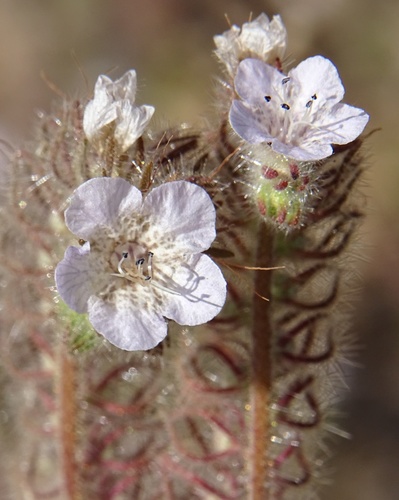


Caterpillar Scorpionweed
phacelia cicutaria
Caterpillar Scorpionweed is an annual herb native to the dry, rocky slopes and chaparral of California, Nevada, and Baja California. Belonging to the borage family, this resilient wildflower is known for its dramatic coiled inflorescences that gradually unfurl as they bloom, presenting a striking visual in spring. Beyond its aesthetic appeal, it plays a critical ecological role as an early-successional species, often blanketing landscapes recently cleared by wildfires. It provides vital nectar for native bees and other pollinators during the spring bloom. However, hikers should admire this plant from a distance, as it is covered in glandular hairs that exude an irritating oil capable of causing severe contact dermatitis.
生息地: Typically found on dry, rocky or gravelly slopes, in chaparral, coastal sage scrub, and open oak woodlands.
This erect annual herb typically grows between 10 and 100 cm tall, featuring highly divided, fern-like leaves that resemble wild celery. Its most distinguishing feature is the scorpioid cymes—coiled flower clusters that look remarkably like fuzzy caterpillars or scorpions' tails. The small, bell-shaped flowers range in color from yellowish-white to pale lavender or blue, each showcasing long, prominent stamens that protrude far past the petals. The entire plant, including the stems and leaves, is densely covered in stiff, sticky, glandular hairs.
カテゴリ
植物レア度
Common
危険度
1/5 · 非常に低い
スナップ
最初にスナップしよう!
Its seeds are highly fire-tolerant, allowing the species to quickly dominate and stabilize slopes after a wildfire has cleared other vegetation.
The common name 'Scorpionweed' refers to the curled flower head's striking resemblance to the curled tail of a scorpion.
The skin reaction caused by touching this plant is so similar to poison oak that it is frequently misidentified by hikers experiencing the rash.
The flower clusters are tightly coiled and slowly unfurl over time, ensuring a prolonged blooming period that maximizes pollination opportunities.
Glandular hairs secrete sticky, irritating oils containing compounds that deter herbivores and can cause allergic contact dermatitis in humans.
Its seeds possess a tough outer coat that can remain dormant in the soil for years, germinating rapidly in response to the heat and ash of wildfires.
As a photoautotroph, Caterpillar Scorpionweed produces its own organic compounds using sunlight, carbon dioxide, and water through photosynthesis.
Bombus vosnesenskii
Pollinates the flowers while foraging for nectar and pollen.
Apis mellifera
Visits flowers during spring blooms to collect nectar.
Sylvilagus audubonii
Occasionally browses on young shoots before the irritating glandular hairs fully develop.
このオブジェクトにはまだ特徴バッジが割り当てられていません。
まだ別名はありません。
テーマが追加されると、このオブジェクトのコレクションがここに表示されます。
危険度
1/5 · 非常に低い
まだ特別な安全上の注意はありません。
Caterpillar Scorpionweedを識別する最も簡単な方法は、Snappit自然識別アプリを使用することです。
10+ cm
1+ 年
As a photoautotroph, Caterpillar Scorpionweed produces its own organic compounds using sunlight, carbon dioxide, and water through photosynthesis.
Typically found on dry, rocky or gravelly slopes, in chaparral, coastal sage scrub, and open oak woodlands.
Photosynthesis
ズームインしてクラスターを分割し、このオブジェクトが撮影された場所を探索しましょう。
新しい観察が追加されると、ここに最近のスナップが表示されます。














.jpg&width=800)


