

Chia
salvia columbariae
Golden Chia (Salvia columbariae) is a captivating, resilient annual wildflower native to the arid and semi-arid landscapes of the southwestern United States and northwestern Mexico. Belonging to the mint family (Lamiaceae), this hardy plant is famous for its remarkable nutritional value and its historical role as a vital food source for Indigenous peoples, including the Cahuilla, Tongva, and Chumash. In the spring, it paints dry slopes and desert washes with striking purple hues, standing out as a beacon of life in seemingly barren environments. Beyond its historical and cultural significance, Golden Chia plays a crucial ecological role. It attracts a wide array of native pollinators, including bees, butterflies, and hummingbirds, while its oil-rich seeds feed many desert birds and small mammals. Its ability to thrive in poor, sandy soils and rapidly regenerate after chaparral fires showcases the incredible adaptability of desert flora.
生息地: Found in dry, sandy, or gravelly soils within coastal sage scrub, chaparral, and desert wash ecosystems across the southwestern United States.
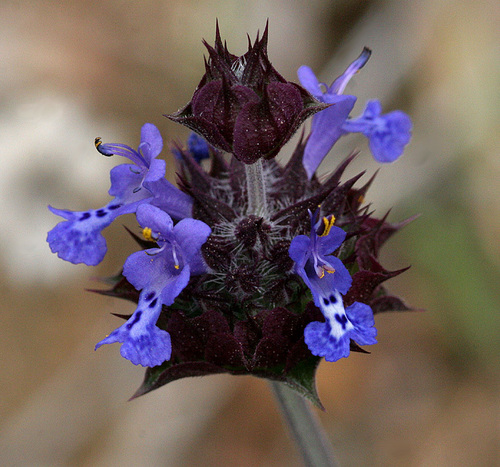
This annual herb typically grows between 10 and 50 centimeters tall, featuring one or more dark purple, square stems. The leaves are mostly basal, gray-green, deeply lobed, and highly textured or wrinkled, growing up to 10 centimeters long. The most distinctive identifier is the presence of one to several spherical, spiky whorls of flowers stacked like beads along the stem, with tiny, two-lipped, deep blue-to-purple flowers emerging from the sharp-tipped bracts.
カテゴリ
植物レア度
Common
危険度
1/5 · 非常に低い
スナップ
最初にスナップしよう!
During the California Gold Rush, miners reportedly used the seeds to help purify alkaline water and make desert spring water more drinkable.
Indigenous peoples of California often mixed the ground seeds with water to create a nutrient-dense, gel-like beverage that could sustain them on long journeys.
The plant's common name 'Chia' is derived from the Nahuatl word 'chian', which translates to 'oily', highlighting the seed's high content of healthy lipids.
When exposed to moisture, the outer layer of the seed swells into a thick gelatinous coat, protecting the seed from drying out and helping it adhere to the desert soil.
The seeds possess a dormancy mechanism that is broken by heat or chemical cues from wood smoke, allowing the plant to rapidly colonize burnt chaparral areas.
As a winter annual, it germinates quickly with winter rains, flowers in spring, and produces seeds before the extreme summer heat arrives.
As a photosynthetic organism, Golden Chia generates its own energy from sunlight, carbon dioxide, and water while absorbing essential minerals from dry desert soils.
Calypte costae
The flowers provide high-energy nectar for pollinators, who in turn fertilize the plant.
Pogonomyrmex californicus
The highly nutritious seeds of Golden Chia are harvested and consumed as a primary food source.
Callipepla californica
The seeds provide critical fat and protein sustenance for desert avian species during dry periods.
このオブジェクトにはまだ特徴バッジが割り当てられていません。
まだ別名はありません。
テーマが追加されると、このオブジェクトのコレクションがここに表示されます。
危険度
1/5 · 非常に低い
まだ特別な安全上の注意はありません。
Chiaを識別する最も簡単な方法は、Snappit自然識別アプリを使用することです。
10-50 cm
1 年
As a photosynthetic organism, Golden Chia generates its own energy from sunlight, carbon dioxide, and water while absorbing essential minerals from dry desert soils.
Found in dry, sandy, or gravelly soils within coastal sage scrub, chaparral, and desert wash ecosystems across the southwestern United States.
ズームインしてクラスターを分割し、このオブジェクトが撮影された場所を探索しましょう。
新しい観察が追加されると、ここに最近のスナップが表示されます。