

Chuparosa
justicia californica
The Chuparosa (Justicia californica) is a striking, perennial desert shrub native to the Sonoran Desert of the southwestern United States and northern Mexico. Growing in tangled, sprawling clumps, this resilient plant is famous for its vibrant displays of tubular red flowers that stand out brilliantly against the arid landscape. Because it is highly adapted to drought conditions, the Chuparosa frequently drops its leaves, presenting as a mass of succulent-like gray-green stems that continue to photosynthesize even in the harshest dry seasons. This species plays a critical ecological role in its native desert habitat, serving as an invaluable nectar source for hummingbirds, which act as its primary pollinators.
生息地: Found in desert washes, rocky canyons, and sandy slopes below 1,000 meters elevation in arid regions.
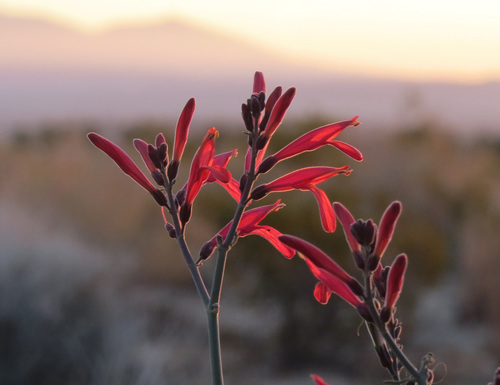
A deciduous, multi-branched shrub reaching heights of up to 150 cm, characterized by a dense, rounded tangle of succulent-like, dull gray-green stems. Its leaves are small, oval, and sparse, appearing briefly after rainfall before dropping. The most prominent identifier is the abundance of tubular, two-lipped flowers measuring 2 to 3 cm long, colored in brilliant shades of fiery red, orange, or occasionally yellow, clustering along the branches.
カテゴリ
植物レア度
Common
危険度
1/5 · 非常に低い
スナップ
最初にスナップしよう!
Because it drops its leaves to survive drought, this plant is functionally leafless for most of its active flowering and growth cycles.
The common name 'Chuparosa' is a regional Spanish colloquialism meaning 'hummingbird', a nod to the birds that constantly swarm the plant.
The sweet-tasting flowers are entirely edible and have a mild flavor reminiscent of fresh cucumber.
Quickly sheds leaves during dry spells to prevent moisture loss, entering a semi-dormant state while surviving on minimal water.
Utilizes chlorophyll-rich green stems to carry out photosynthesis even when entirely leafless, maximizing energy production in harsh conditions.
Produces bright tubular flowers evolved specifically to fit the long bills of hummingbirds, ensuring highly effective pollination.
Creates its own food by capturing solar energy and carbon dioxide, while absorbing essential water and mineral nutrients through its root system.
Calypte costae
Provides critical nectar during winter and spring nesting seasons.
Ovis canadensis nelsoni
Frequently browses on the tender stems and leaves during drought periods.
Archilochus alexandri
Feeds on nectar and assists in cross-pollination of flowers.
このオブジェクトにはまだ特徴バッジが割り当てられていません。
まだ別名はありません。
テーマが追加されると、このオブジェクトのコレクションがここに表示されます。
危険度
1/5 · 非常に低い
まだ特別な安全上の注意はありません。
Chuparosaを識別する最も簡単な方法は、Snappit自然識別アプリを使用することです。
100-150 cm
15-50 年
Creates its own food by capturing solar energy and carbon dioxide, while absorbing essential water and mineral nutrients through its root system.
Found in desert washes, rocky canyons, and sandy slopes below 1,000 meters elevation in arid regions.
Photosynthesis
ズームインしてクラスターを分割し、このオブジェクトが撮影された場所を探索しましょう。
新しい観察が追加されると、ここに最近のスナップが表示されます。

Arizona, US
ここで見られるかも Chuparosa, ヴァーディン と American Threefold.
ガイドを見る →

California, US
ここで見られるかも クレオソートブッシュ, ブリットルブッシュ と Beavertail Pricklypear.
ガイドを見る →
California, US
ここで見られるかも クレオソートブッシュ, ブリットルブッシュ と Beavertail Pricklypear.
ガイドを見る →