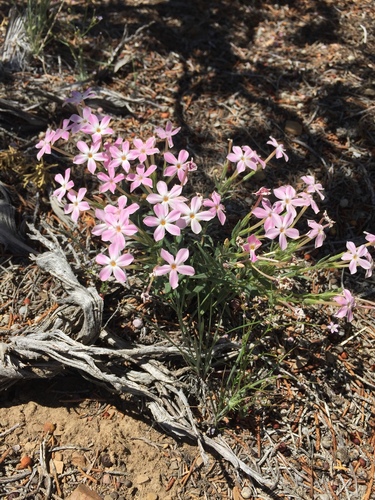


Cold Desert Phlox
phlox stansburyi
Cold Desert Phlox, scientifically known as Phlox stansburyi, is a hardy perennial wildflower native to the arid landscapes of the Western United States. Standing as a colorful beacon in otherwise dusty terrains, this resilient plant thrives where many others fail, lighting up sagebrush deserts and rocky slopes with its beautiful pink and purple blossoms in late spring. It plays a vital role in its native ecosystem by providing an early-season nectar source for a variety of long-tongued pollinators, including butterflies and hawkmoths, which are drawn to its fragrant, tubular blooms.
生息地: Found in dry, open habitats including rocky slopes, sagebrush scrub, and pinyon-juniper woodlands across the western Great Basin.
This low-growing perennial or subshrub typically reaches 10 to 30 centimeters in height, forming clumped, woody bases. Its opposite, lance-shaped leaves are stiff, narrow, and coated in distinctive sticky, glandular hairs. The flowers are the plant's most striking feature, sporting five-lobed, flat-faced petals that range from pale pink and lavender to deep rose, centered around a narrow tube that is 1 to 2 centimeters long.
カテゴリ
植物レア度
Common
危険度
1/5 · 非常に低い
スナップ
最初にスナップしよう!
Its long, tubular flower throat restricts nectar access to specialized pollinators with long proboscises, ensuring highly efficient pollination.
The species name 'stansburyi' honors Howard Stansbury, a 19th-century US Army officer who led a major scientific expedition to explore the Great Salt Lake basin.
The sticky residue on its leaves acts like natural flypaper, which may prevent destructive crawling pests from reaching and consuming the flowers.
Stems and leaves are coated in sticky, glandular hairs that deter crawling insect predators and help reduce moisture loss in dry winds.
An extensive, woody taproot system anchors the plant deep into rocky crevices to access moisture reserves during dry summer months.
Its low-growing, compact growth form protects it from severe desert winds and helps trap micro-humidity near the ground.
Like all green plants, Cold Desert Phlox synthesizes its own food using sunlight, carbon dioxide, water, and essential soil nutrients.
Hyles lineata
Adult moths visit the flowers to drink nectar, pollinating the phlox in the process.
Odocoileus hemionus
Deer occasionally browse the tender early-spring foliage of this subshrub in times of food scarcity.
Artemisia tridentata
Competes directly for soil moisture and scarce nutrient resources in dry Great Basin soils.
このオブジェクトにはまだ特徴バッジが割り当てられていません。
まだ別名はありません。
テーマが追加されると、このオブジェクトのコレクションがここに表示されます。
危険度
1/5 · 非常に低い
まだ特別な安全上の注意はありません。
Cold Desert Phloxを識別する最も簡単な方法は、Snappit自然識別アプリを使用することです。
10-30 cm
3-10 年
Like all green plants, Cold Desert Phlox synthesizes its own food using sunlight, carbon dioxide, water, and essential soil nutrients.
Found in dry, open habitats including rocky slopes, sagebrush scrub, and pinyon-juniper woodlands across the western Great Basin.
ズームインしてクラスターを分割し、このオブジェクトが撮影された場所を探索しましょう。
新しい観察が追加されると、ここに最近のスナップが表示されます。









.jpg&width=800)








_al_Montseny_(Catalunya).jpg&width=800)
