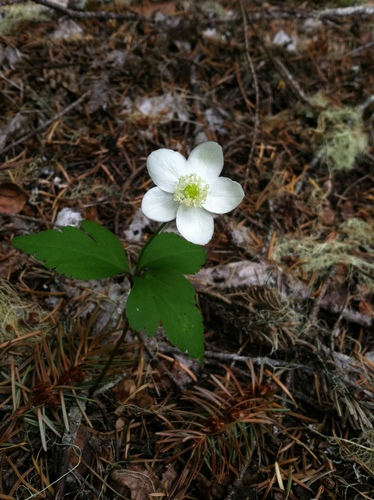


Columbian Windflower
anemonastrum deltoideum
The Columbian Windflower, scientifically known as Anemonastrum deltoideum, is a charming and delicate perennial herb native to the moist, shaded forest floors of western North America. It is a harbinger of spring, often among the first wildflowers to emerge and bloom, taking advantage of the sunlight that penetrates the forest canopy before the deciduous trees fully leaf out. This species is admired for its simple beauty and its role in forest ecosystems, providing early season nectar for pollinators and its seeds contributing to forest regeneration through unique dispersal mechanisms. Its presence signals the awakening of the woodland after winter, making it a beloved sight for hikers and nature enthusiasts.
生息地: The Columbian Windflower thrives in moist, cool, and shady environments, typically found on the forest floor of coniferous, mixed, or deciduous woodlands at low to mid-elevations.
This slender wildflower typically grows 10 to 30 centimeters tall, featuring a delicate stem that emerges from the forest floor. Its most striking feature is its solitary, usually three-petaled (actually petal-like sepals) white flower, which may occasionally exhibit a faint pinkish tint on its underside. The center of the flower is adorned with a cluster of vibrant yellow stamens, providing a lovely contrast. The basal leaves are dark green, deeply three-lobed (trifoliate) with toothed margins, forming an attractive ground cover beneath the blooming stems.
カテゴリ
植物レア度
Common
危険度
1/5 · 非常に低い
スナップ
最初にスナップしよう!
Despite its delicate look, Anemonastrum deltoideum is a resilient perennial, returning year after year from its underground rhizomes.
Its 'petals' are actually sepals; this is common in the Ranunculaceae family, where sepals are often colorful and petal-like.
The common name 'Windflower' likely comes from its delicate appearance and how its petals (actually sepals) seem to flutter in the slightest breeze.
The specific epithet 'deltoideum' refers to the somewhat triangular or deltoid shape of its leaves or sometimes the three sepals of the flower.
This plant capitalizes on the brief window of abundant sunlight in early spring before the overhead tree canopy fully develops, allowing it to complete much of its life cycle before deeper shade sets in.
Anemonastrum deltoideum spreads efficiently through underground rhizomes, enabling it to form clonal colonies and effectively colonize suitable patches of forest floor.
Its seeds are equipped with elaiosomes, fatty appendages that attract ants, which then carry the seeds to their nests, aiding in dispersal and often burying them in nutrient-rich soil.
As an autotrophic plant, the Columbian Windflower produces its own food through photosynthesis, converting sunlight into energy. It absorbs water and essential mineral nutrients from the soil through its root system.
Bombus pratorum
Pollinator, attracted by nectar and pollen.
Odocoileus hemionus columbianus
Herbivore that may browse on leaves or flowers.
Formica obscuripes
Seed disperser, attracted to elaiosomes on seeds.
Various species
Fungal associate, forming beneficial mycorrhizal relationships with roots.
このオブジェクトにはまだ特徴バッジが割り当てられていません。
まだ別名はありません。
テーマが追加されると、このオブジェクトのコレクションがここに表示されます。
危険度
1/5 · 非常に低い
まだ特別な安全上の注意はありません。
Columbian Windflowerを識別する最も簡単な方法は、Snappit自然識別アプリを使用することです。
10-30 cm
0.005-0.02 kg
5-20 年
As an autotrophic plant, the Columbian Windflower produces its own food through photosynthesis, converting sunlight into energy. It absorbs water and essential mineral nutrients from the soil through its root system.
The Columbian Windflower thrives in moist, cool, and shady environments, typically found on the forest floor of coniferous, mixed, or deciduous woodlands at low to mid-elevations.
Foraging For Nutrients
50-200
ズームインしてクラスターを分割し、このオブジェクトが撮影された場所を探索しましょう。
新しい観察が追加されると、ここに最近のスナップが表示されます。


















