

Coral Greenbrier
smilax walteri
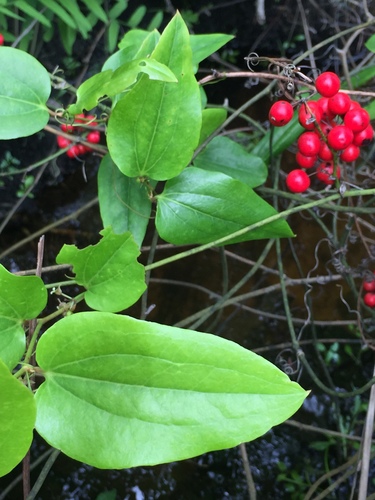
The Coral Greenbrier, scientifically known as Smilax walteri, is a native woody vine of the southeastern United States. Renowned for its brilliant display of vibrant red berries that persist long into the winter, this species adds a splash of striking color to dull winter wetlands. It utilizes slender tendrils to scramble over adjacent shrubs and trees in acidic, swampy environments. Unlike many of its fiercely armed relatives, this greenbrier is relatively gentle, featuring few to no prickles along its stems. This vine serves as a crucial ecological resource, providing essential winter nourishment for local bird populations and dense cover for various small wetland creatures. Its ability to thrive in waterlogged, acidic soils makes it a key structural component of southeastern bog and floodplain ecosystems.
生息地: Found in acidic swamps, coastal plain wetlands, bogs, and wet pine flatwoods across the southeastern United States.
This woody vine is characterized by slender, bright green stems that can climb up to 6 meters high, often lacking the sharp prickles common to other Smilax species. It bears alternate, bright green, ovate to lanceolate leaves with prominent parallel veins. In spring, it produces small, inconspicuous clusters of greenish-yellow flowers. The plant's most identifying feature is its dense clusters of glossy, coral-red, globose berries, each measuring about 6 to 8 millimeters in diameter. These berries ripen in the autumn and remain brightly colored and attached to the vine throughout the winter, even after the deciduous leaves have fallen.
カテゴリ
植物レア度
Common
危険度
1/5 · 非常に低い
スナップ
最初にスナップしよう!
Its vibrant red berries are heavy with saponins, making them unpalatable to humans but highly favored by overwintering birds.
The common name Greenbrier refers to the woody stems which remain bright green and carry out photosynthesis year-round.
Unlike many of its aggressive, painfully thorny relatives, the Coral Greenbrier is mostly smooth and thornless.
Uses highly sensitive, paired tendrils growing from the leaf bases to wrap tightly around surrounding vegetation, allowing it to climb toward sunlight.
Possesses specialized physiological adaptations that allow its root system to survive and function in hypoxic, waterlogged swamp soils.
Retains its bright red berries throughout the freezing winter months, ensuring a steady food source for seed-dispersing birds when other resources are depleted.
As a photosynthetic plant, it manufactures its own sugars using chlorophyll to capture sunlight, combining it with water, carbon dioxide, and essential soil minerals.
Cardinalis cardinalis
The bright red berries are a critical winter food source for this native songbird.
Odocoileus virginianus
White-tailed deer frequently browse the tender young shoots and leaves in the spring.
Phyprosopus callitrichoides
The larvae of this moth feed selectively on the foliage of Smilax species.
このオブジェクトにはまだ特徴バッジが割り当てられていません。
まだ別名はありません。
テーマが追加されると、このオブジェクトのコレクションがここに表示されます。
危険度
1/5 · 非常に低い
まだ特別な安全上の注意はありません。
Coral Greenbrierを識別する最も簡単な方法は、Snappit自然識別アプリを使用することです。
100-600 cm
5-30 年
As a photosynthetic plant, it manufactures its own sugars using chlorophyll to capture sunlight, combining it with water, carbon dioxide, and essential soil minerals.
Found in acidic swamps, coastal plain wetlands, bogs, and wet pine flatwoods across the southeastern United States.
ズームインしてクラスターを分割し、このオブジェクトが撮影された場所を探索しましょう。
新しい観察が追加されると、ここに最近のスナップが表示されます。