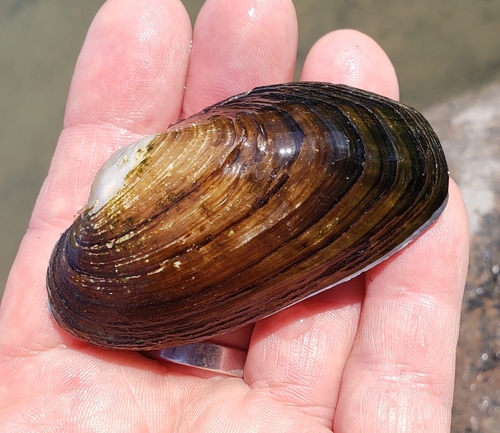


Creeper
strophitus undulatus
The Creeper, Strophitus undulatus, is a fascinating freshwater mussel native to eastern North America. This bivalve plays a vital role in aquatic ecosystems by acting as a natural water filter, improving water clarity and quality for other organisms. It exhibits a truly remarkable reproductive strategy, where its microscopic larval stage, called glochidia, must temporarily parasitize the gills or fins of certain fish species. This reliance on a host fish for dispersal ensures its survival and spread throughout river and lake systems. Despite its seemingly simple existence, the Creeper is a testament to the intricate interconnections within freshwater environments, highlighting the hidden biodiversity beneath the water's surface.
生息地: Found in a variety of stable freshwater environments, including rivers, streams, lakes, and ponds, typically buried in sand, gravel, or cobble substrates.
The Creeper typically possesses an oval to subtrapezoidal shell, reaching lengths of 5 to 10 centimeters. Its exterior coloration ranges from greenish-brown to dark brown or black, often displaying concentric growth rings that indicate age. The shell surface can be relatively smooth or show subtle undulations, particularly in younger individuals. Internally, the nacre (mother-of-pearl) is usually bluish-white, though it can sometimes exhibit salmon or pinkish hues, especially near the umbo (beak). The shells are moderately thick and somewhat inflated.
カテゴリ
Invertebrateレア度
Common
危険度
1/5 · 非常に低い
スナップ
最初にスナップしよう!
A single female Creeper can release hundreds of thousands of microscopic glochidia larvae to maximize their chances of finding a fish host.
Adult Creeper mussels can live for several decades, contributing to water purification throughout their long lives.
The Creeper gets its common name from its unique reproductive strategy, where its larvae "creep" onto host fish.
Unlike many mussels, the female Creeper often produces an elaborate, fish-like lure on her mantle to attract suitable host fish for her glochidia.
Creeper mussels have a unique life cycle where their microscopic larvae, called glochidia, attach to the gills or fins of specific fish species for a temporary parasitic period. This stage is crucial for their dispersal and development into juvenile mussels.
As adult mussels, Creepers continuously filter water, removing suspended particles such as algae, bacteria, and detritus. This activity significantly contributes to water clarity and ecosystem health.
Female Creeper mussels have evolved elaborate mantle flaps that mimic small fish or insect larvae. This visual lure attracts host fish, prompting them to investigate, at which point the mussel releases its glochidia, which attach to the unsuspecting fish.
The Creeper is a sedentary filter feeder, consuming microscopic organic matter and microorganisms suspended in the water column. It draws water through an incurrent siphon and extracts food particles before expelling filtered water through an excurrent siphon.
年齢による違い: The larval (glochidia) stage is parasitic, feeding on nutrients from the tissues of its host fish. Upon metamorphosis, it becomes a free-living filter feeder.
Micropterus salmoides
Host for the mussel's parasitic larval stage (glochidia).
Various species
Primary food source for adult mussels.
Ondatra zibethicus
Potential predator of mussels.
Dreissena polymorpha
Non-native invasive species that competes for resources and space.
このオブジェクトにはまだ特徴バッジが割り当てられていません。
まだ別名はありません。
テーマが追加されると、このオブジェクトのコレクションがここに表示されます。
危険度
1/5 · 非常に低い
まだ特別な安全上の注意はありません。
Creeperを識別する最も簡単な方法は、Snappit自然識別アプリを使用することです。
5-10 cm
0.05-0.2 kg
10-30 年
The Creeper is a sedentary filter feeder, consuming microscopic organic matter and microorganisms suspended in the water column. It draws water through an incurrent siphon and extracts food particles before expelling filtered water through an excurrent siphon.
Found in a variety of stable freshwater environments, including rivers, streams, lakes, and ponds, typically buried in sand, gravel, or cobble substrates.
Filtering
ズームインしてクラスターを分割し、このオブジェクトが撮影された場所を探索しましょう。
新しい観察が追加されると、ここに最近のスナップが表示されます。











