

Creeping Baby'S-Breath
gypsophila repens
Creeping Baby's-Breath, Gypsophila repens, is a delightful perennial herbaceous plant known for its delicate appearance and mat-forming habit. This species is highly valued in horticulture for its abundance of tiny, star-like flowers that create a soft, airy effect, often used to soften hard landscaping features or spill over rockeries. Native to mountainous regions, it is remarkably hardy and well-adapted to harsh conditions, making it a robust yet charming addition to various gardens. Its low-growing, spreading nature makes it an excellent groundcover, providing a blanket of white or pale pink blooms throughout the summer months.
生息地: Found in rocky subalpine and alpine environments, scree slopes, and stony pastures in mountainous regions of Europe.
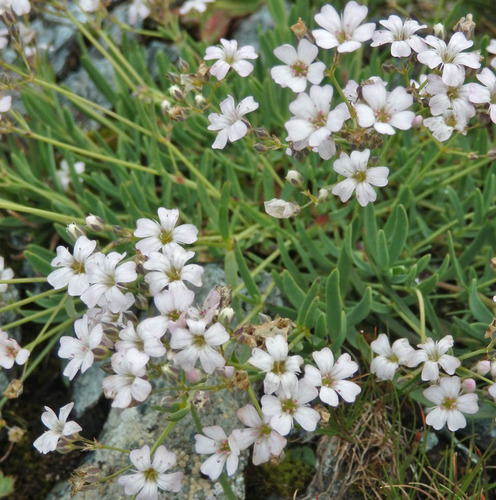
This low-growing perennial forms dense, spreading mats, typically reaching 5-20 cm in height. Its foliage consists of small, lance-shaped, blue-green leaves. The plant produces a profusion of tiny, five-petaled flowers, usually white, though sometimes pale pink, each measuring about 0.5-1 cm in diameter. These delicate blooms are borne in loose, airy clusters on slender stems, creating a cloud-like appearance over the mat of foliage.
カテゴリ
植物レア度
Common
危険度
1/5 · 非常に低い
スナップ
最初にスナップしよう!
Despite its delicate appearance, Creeping Baby's-Breath is remarkably tough and can thrive in poor, rocky soils and harsh alpine conditions where many other plants struggle.
Its low-growing, mat-forming habit makes it an ideal choice for suppressing weeds and preventing soil erosion on slopes or in between paving stones, making it a popular landscape plant.
Some species of Gypsophila contain saponins, which are natural soap-like compounds; historically, roots of related species have been used to make soap or detergent.
The genus name 'Gypsophila' literally means 'gypsum-loving,' referring to the plant's natural preference for calcium-rich (often gypsum-containing) soils.
The plant has a prostrate, mat-forming growth habit, allowing it to spread effectively over rocky or uneven terrain and act as a groundcover, preventing soil erosion.
Adapted to well-drained, often dry conditions found in its native mountain habitats, it can withstand periods of low moisture once established due to its efficient water usage.
Gypsophila repens thrives in alkaline (calcium-rich) soils, a common characteristic of the limestone-rich mountain ranges where it naturally occurs.
As a photosynthetic plant, Gypsophila repens produces its own food by converting light energy into chemical energy, utilizing carbon dioxide, water, and essential minerals absorbed from its environment.
Apis mellifera
Pollination for reproduction of the plant.
Cornu aspersum
Minor herbivory on leaves and stems by generalist feeders.
Various species (e.g., Glomeromycota)
Symbiotic relationship with fungi in the soil, enhancing nutrient and water uptake.
このオブジェクトにはまだ特徴バッジが割り当てられていません。
まだ別名はありません。
テーマが追加されると、このオブジェクトのコレクションがここに表示されます。
危険度
1/5 · 非常に低い
まだ特別な安全上の注意はありません。
Creeping Baby'S-Breathを識別する最も簡単な方法は、Snappit自然識別アプリを使用することです。
5-20 cm
0.01-0.1 kg
3-10 年
As a photosynthetic plant, Gypsophila repens produces its own food by converting light energy into chemical energy, utilizing carbon dioxide, water, and essential minerals absorbed from its environment.
Found in rocky subalpine and alpine environments, scree slopes, and stony pastures in mountainous regions of Europe.
Photosynthesis And Nutrient Absorption
20-60
ズームインしてクラスターを分割し、このオブジェクトが撮影された場所を探索しましょう。
新しい観察が追加されると、ここに最近のスナップが表示されます。