

Cypress Vine
ipomoea quamoclit
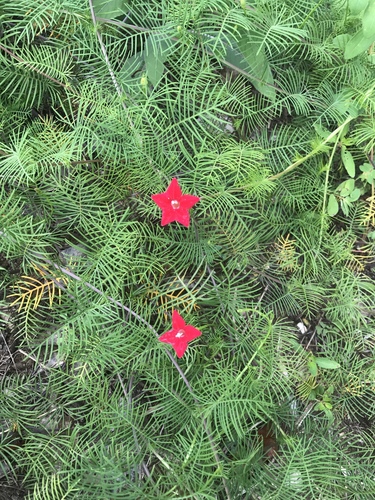
The Cypress Vine (Ipomoea quamoclit) is an enchanting, fast-growing annual climbing vine famous for its delicate, fern-like foliage and brilliant, star-shaped flowers. Belonging to the morning glory family, this vigorous climber twines effortlessly around trellises, fences, and neighboring plants, adding vertical drama to any landscape. It is highly valued by gardeners not only for its aesthetic appeal but also for its remarkable ability to attract vital pollinators.
生息地: Found in disturbed open fields, forest edges, roadsides, and cultivated garden spaces, typically thriving in warm, sun-drenched tropical and temperate regions.
This vine features deeply dissected, thread-like green leaves that resemble feathery cypress needles, creating a light, airy canopy. Its striking flowers are tubular and flare open into five-pointed stars, typically measuring about 2 to 3 centimeters across. While bright scarlet red is the most common color, pink and white variations also occur. The slender stems climb to heights of 1 to 6 meters by twining tightly around any available support.
カテゴリ
植物レア度
Common
危険度
1/5 · 非常に低い
スナップ
最初にスナップしよう!
Despite its common name, it is a true member of the morning glory family and not closely related to true cypress trees.
In India, it is sometimes called 'Kamalata' or 'Love's Vine', carrying romantic cultural significance in local folklore.
The seeds of this plant contain small amounts of hallucinogenic morning glory alkaloids and are toxic if ingested by pets or humans.
Uses fast-growing, highly sensitive twining stems to wrap around structures and other plants, ascending rapidly to claim light.
Produces sweet, deeply located nectar that specifically lures long-beaked hummingbirds and specialized moths for pollination.
Possesses highly divided leaves that minimize wind drag and physical damage while maximizing light absorption in crowded environments.
As a photosynthetic plant, the Cypress Vine synthesizes its own organic compounds using sunlight, carbon dioxide, water, and soil minerals.
Archilochus colubris
Feeds on nectar and serves as the primary pollinator for the flowers.
Agrius cingulata
Larvae of this moth feed on the foliage of Cypress Vine.
Apis mellifera
Visits flowers to gather pollen and assist in pollination.
このオブジェクトにはまだ特徴バッジが割り当てられていません。
まだ別名はありません。
テーマが追加されると、このオブジェクトのコレクションがここに表示されます。
危険度
1/5 · 非常に低い
まだ特別な安全上の注意はありません。
Cypress Vineを識別する最も簡単な方法は、Snappit自然識別アプリを使用することです。
100-600 cm
1 年
As a photosynthetic plant, the Cypress Vine synthesizes its own organic compounds using sunlight, carbon dioxide, water, and soil minerals.
Found in disturbed open fields, forest edges, roadsides, and cultivated garden spaces, typically thriving in warm, sun-drenched tropical and temperate regions.
Photosynthesis
7-21 日
ズームインしてクラスターを分割し、このオブジェクトが撮影された場所を探索しましょう。
新しい観察が追加されると、ここに最近のスナップが表示されます。
















_Geum_rivale_-_flower_and_bottoms.jpg&width=800)
