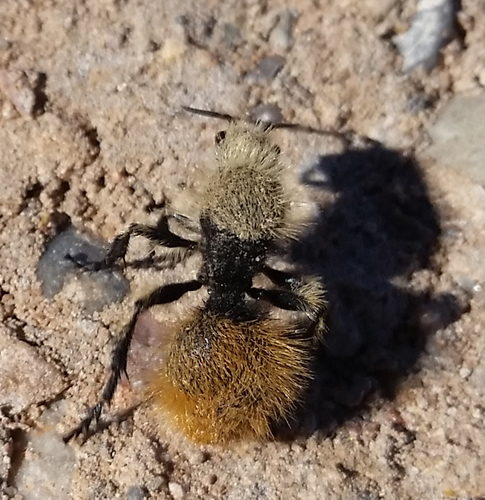


Dasymutilla Magna
dasymutilla magna
Dasymutilla magna, commonly known as a velvet ant, is a striking and fascinating insect belonging to the family Mutillidae. Despite their common name and ant-like appearance, these creatures are actually solitary wasps. The females are entirely wingless and scurry rapidly across sandy soils, while the males possess transparent wings and spend much of their time flying low in search of mates. Their vibrant, dense coats of fuzzy hair act as aposematic warning coloration, signaling to potential predators that they are dangerous. What makes Dasymutilla magna truly remarkable is its formidable suite of defenses. Females possess an exceptionally long stinger relative to their body size, delivering a notoriously painful sting that has earned their relatives the nickname 'cow killers'. Additionally, they sport an incredibly thick, armor-like exoskeleton that protects them from the defensive bites and stings of the ground-nesting bees and wasps whose nests they invade to lay their eggs.
生息地: Predominantly found in arid and semi-arid environments, including desert scrub, sandy dunes, and dry grasslands with sparse vegetation.
This species is characterized by a robust, somewhat elongated body measuring roughly 1 to 3 centimeters in length. Females are wingless and densely covered in coarse, velvety setae (hairs) that are typically a vibrant yellowish-orange to rusty red across the thorax and abdomen, contrasting sharply with their glossy black legs, antennae, and underbelly. Males share similar, though sometimes duller, coloration but are easily distinguished by the presence of large, translucent, dark-tinted wings. Both sexes possess heavy, armored exoskeletons that give them a distinctively rigid, sturdy appearance as they move.
カテゴリ
昆虫レア度
Common
危険度
1/5 · 非常に低い
スナップ
最初にスナップしよう!
Despite being called 'velvet ants', they are actually a family of solitary wasps where the females have completely lost their wings through evolution.
The bright orange and red colors of this insect are a classic example of aposematism, a biological strategy used to advertise danger to potential predators.
The exoskeleton of a velvet ant is so exceptionally tough that entomologists sometimes bend their steel mounting pins when trying to add them to a museum collection.
Their sting is incredibly painful, famously ranking near the top of the Schmidt sting pain index, though its venom is relatively non-toxic to humans.
Females possess an exceptionally long, highly maneuverable stinger capable of delivering an intensely painful venom to deter threats.
Their heavily sclerotized, rounded exoskeleton is incredibly tough, allowing them to withstand bites, stings, and crushing forces from predators.
When threatened, they can rub segments of their abdomen together to produce a high-pitched squeaking sound that serves as an auditory warning.
Adults primarily feed on nectar and water, while their larval stage is strictly carnivorous, developing as ectoparasitoids on the immature stages of other insects.
年齢による違い: Larvae are entirely carnivorous ectoparasitoids feeding on a single host insect, whereas adults shift entirely to a liquid diet of plant nectar and water.
Bembix americana
Females parasitize the nests of ground-nesting solitary wasps and bees.
Geococcyx californianus
Occasionally preyed upon by specialized desert birds that can safely bypass their sting and tough armor.
Encelia farinosa
Adults visit desert flowers for nectar, acting as minor pollinators.
このオブジェクトにはまだ特徴バッジが割り当てられていません。
まだ別名はありません。
テーマが追加されると、このオブジェクトのコレクションがここに表示されます。
危険度
1/5 · 非常に低い
まだ特別な安全上の注意はありません。
Dasymutilla Magnaを識別する最も簡単な方法は、Snappit自然識別アプリを使用することです。
1-3 cm
1-3 cm
0.0001-0.0005 kg
0-1 年
Adults primarily feed on nectar and water, while their larval stage is strictly carnivorous, developing as ectoparasitoids on the immature stages of other insects.
Predominantly found in arid and semi-arid environments, including desert scrub, sandy dunes, and dry grasslands with sparse vegetation.
Foraging
ズームインしてクラスターを分割し、このオブジェクトが撮影された場所を探索しましょう。
新しい観察が追加されると、ここに最近のスナップが表示されます。















