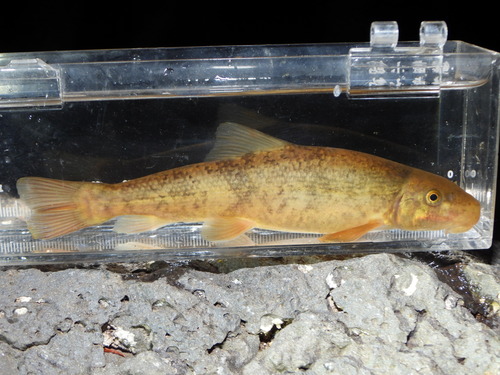


Desert Sucker
pantosteus clarkii
The Desert Sucker (Pantosteus clarkii) is a robust freshwater fish species well-adapted to the often harsh and fluctuating conditions of desert aquatic environments. As a bottom-dweller, it plays a vital ecological role as a primary consumer, meticulously grazing on algae and detritus, thereby contributing significantly to nutrient cycling and stream health. Its specialized mouthparts and streamlined body are prime examples of adaptation to life in fast-flowing, rocky stream beds, making it a resilient and fascinating inhabitant of the American Southwest's waterways.
生息地: Found in clear, cool to warm water streams and rivers with moderate to swift currents, typically over rocky or gravelly substrates, often in riffles and runs.
This fish typically exhibits an olive to brownish coloration on its back and sides, fading to a lighter, often yellowish-white belly. Its body is elongated and cylindrical, with a notably flattened underside that allows it to cling to rocks. Key identifiers include its distinctive subterminal mouth, located on the underside of its head, which is modified into a fleshy, suction-cup-like disc. It possesses relatively small, fine scales and usually has a dark spot or blotch at the base of its caudal fin. Adults can reach lengths of up to 30 centimeters.
カテゴリ
魚類レア度
Common
危険度
1/5 · 非常に低い
スナップ
最初にスナップしよう!
Despite their name, Desert Suckers are highly adapted to the extreme temperature fluctuations and intermittent flows often found in desert rivers and streams.
The Desert Sucker's common name is derived from its unique mouth, which functions like a suction cup to cling to rocks and scrape food.
Their continuous grazing on algae helps prevent excessive algal growth in streams, maintaining a balanced aquatic ecosystem.
They are considered an indicator species for stream health; a healthy population often signifies good water quality and riparian habitat.
The Desert Sucker's subterminal mouth forms a fleshy, papillose disc, enabling it to adhere tightly to rocks and other substrates, preventing it from being swept away by strong currents.
Its fusiform, somewhat flattened body shape reduces drag, allowing the fish to maintain its position in fast-flowing waters with minimal effort, an essential adaptation for lotic environments.
The specialized mouthparts, including a cartilaginous scraping edge, are perfectly adapted for efficiently rasping and consuming periphyton (algae and diatoms) and detritus from submerged surfaces.
The Desert Sucker primarily grazes on algae, diatoms, and organic detritus found clinging to submerged rocks and other surfaces. It also consumes small quantities of aquatic insect larvae incidentally.
年齢による違い: Diet remains largely consistent throughout its life cycle, focusing on benthic algae and detritus, though larger individuals may consume a slightly broader range of incidentally ingested invertebrates.
Micropterus salmoides
Larger predatory fish often prey on juvenile and adult Desert Suckers.
Bacillariophyceae (various species)
These microscopic aquatic plants form a critical food source, scraped directly from surfaces.
Catostomus latipinnis
Other bottom-dwelling fish compete for the same food resources and physical space.
Argulus sp.
These crustaceans are common external parasites found on many freshwater fish, including suckers.
このオブジェクトにはまだ特徴バッジが割り当てられていません。
まだ別名はありません。
テーマが追加されると、このオブジェクトのコレクションがここに表示されます。
危険度
1/5 · 非常に低い
まだ特別な安全上の注意はありません。
Desert Suckerを識別する最も簡単な方法は、Snappit自然識別アプリを使用することです。
10-30 cm
0.05-0.4 kg
5-10 年
The Desert Sucker primarily grazes on algae, diatoms, and organic detritus found clinging to submerged rocks and other surfaces. It also consumes small quantities of aquatic insect larvae incidentally.
Found in clear, cool to warm water streams and rivers with moderate to swift currents, typically over rocky or gravelly substrates, often in riffles and runs.
Grazing/scraping
1000-10000
ズームインしてクラスターを分割し、このオブジェクトが撮影された場所を探索しましょう。
新しい観察が追加されると、ここに最近のスナップが表示されます。

















