

Devil'S Spineflower
chorizanthe rigida
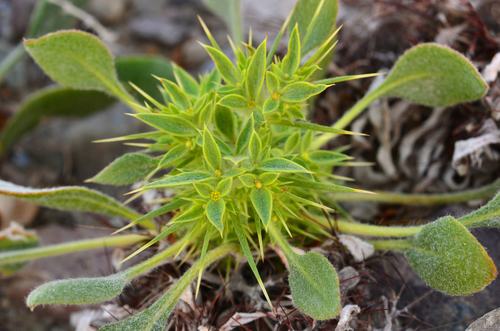
The Devil's Spineflower (Chorizanthe rigida) is a fascinating desert-adapted annual plant that thrives in some of the harshest arid regions of North America. During the fleeting wet winter months, it emerges as a low-profile rosette with soft, greenish-gray leaves and inconspicuous yellow flowers. However, as the blistering summer heat sets in, the plant undergoes a dramatic transformation: its fleshy parts die off, leaving behind a rigid, blackened, spine-covered skeleton that can persist in the desert landscape for several years. This ghostly wooden framework plays a crucial role in the plant's survival, guarding its seeds from hungry desert herbivores and ensuring that the next generation remains protected until the heavy rains arrive once more.
生息地: Found on gravelly desert flats, alluvial fans, and rocky slopes of the Mojave and Sonoran deserts.
Typically growing between 5 and 15 centimeters in height, the Devil's Spineflower has a highly distinctive structural form. When young and actively growing, it features broad, rounded, white-woolly leaves clustered at the base, with tiny yellow flowers nestled inside spiny bracts. As it dries, the leaves fall away and the stems harden into a stiff, star-like or cone-shaped cluster of dark grey to charcoal-black thorns. This rigid, spine-tipped skeletal carcass looks almost like charred wood or miniature metal spikes, making it incredibly easy to recognize against the pale desert gravel.
カテゴリ
植物レア度
Common
危険度
1/5 · 非常に低い
スナップ
最初にスナップしよう!
Despite its intimidating, thorny appearance when dried, the young plant starts life with remarkably soft, fuzzy, and harmless green leaves.
Its scientific name 'rigida' perfectly describes the stiff, unyielding nature of its dried stems, which do not decay easily in the dry desert air.
The dried, spiny skeletons of this plant can persist in the desert environment for several years after the plant has died, acting as a natural barbed-wire protection for its seeds.
After dying, the plant's rigid, spine-covered woody structure remains intact for years, physically protecting the seeds enclosed within from granivorous animals.
It quickly germinates, flowers, and sets seeds during brief winter rains, escaping the extreme summer heat by completing its life cycle before the drought peaks.
The dried spiny bracts open and release their seeds primarily in response to moisture, ensuring seed dispersal occurs when conditions are favorable for germination.
As a photosynthetic plant, the Devil's Spineflower produces its own energy using sunlight, water, and carbon dioxide, drawing essential minerals from the rocky desert soil.
Gopherus agassizii
The succulent young leaves of the growing plant are sometimes consumed by desert tortoises during the early spring.
Chaetodipus penicillatus
Desert pocket mice forage for the seeds of this plant, though they must bypass the spiny skeleton to reach them.
Perdita spp.
Tiny solitary bees visit the small yellow flowers for nectar and pollen, acting as key pollinators during the spring bloom.
このオブジェクトにはまだ特徴バッジが割り当てられていません。
まだ別名はありません。
テーマが追加されると、このオブジェクトのコレクションがここに表示されます。
危険度
1/5 · 非常に低い
まだ特別な安全上の注意はありません。
Devil'S Spineflowerを識別する最も簡単な方法は、Snappit自然識別アプリを使用することです。
3-15 cm
0.001-0.01 kg
0-1 年
As a photosynthetic plant, the Devil's Spineflower produces its own energy using sunlight, water, and carbon dioxide, drawing essential minerals from the rocky desert soil.
Found on gravelly desert flats, alluvial fans, and rocky slopes of the Mojave and Sonoran deserts.
ズームインしてクラスターを分割し、このオブジェクトが撮影された場所を探索しましょう。
新しい観察が追加されると、ここに最近のスナップが表示されます。

California, US
ここで見られるかも Iodinebush, ジェルバマンサ と Golden Gilmania.
ガイドを見る →

California, US
ここで見られるかも Desert Holly, Western Joshua Tree と クレオソートブッシュ.
ガイドを見る →

California, US
ここで見られるかも Frémont's Phacelia と Devil's Spineflower.
ガイドを見る →

California, US
ここで見られるかも Desert Holly, Desert Sunflower と Desert Fivespot.
ガイドを見る →












_0120.JPG&width=800)