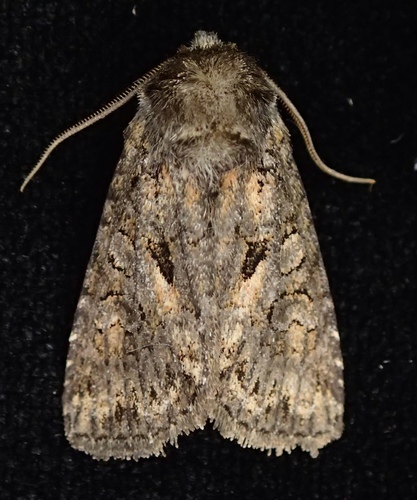


Disparaged Arches Moth
orthodes detracta
The Disparaged Arches Moth (Orthodes detracta) is a subtle yet fascinating member of the owlet moth family, Noctuidae. Found throughout deciduous woodlands and forest edges in North America, this nocturnal insect blends effortlessly into its surroundings. Despite its slightly gloomy common name, it is an essential pollinator and a key component of forest food webs, serving as a vital food source for bats and nocturnal birds.
生息地: Typically found in deciduous forests, mixed woodlands, shrubby old fields, and damp forest edges across eastern North America.
This moth features a wingspan ranging from 2.7 to 3.5 cm, characterized by forewings with a mottled gray, brown, and occasionally purplish hue. Key markings include pale-ringed, dark-centered orbicular and reniform (kidney-shaped) spots, bordered by subtle wavy black transverse lines. The hindwings are a more uniform, dusky grayish-brown, often lighter toward the base, allowing the moth to remain perfectly camouflaged when resting flat against tree bark.
カテゴリ
昆虫レア度
Common
危険度
1/5 · 非常に低い
スナップ
最初にスナップしよう!
The common name 'Disparaged Arches' refers to the subtle, arched markings on its wings which historically were considered less distinct or 'disparaged' compared to other arches moths.
These moths possess a specialized 'ear' on each side of their thorax, specifically designed to hear the high-frequency echolocation calls of bats so they can quickly drop to the ground.
They overwinter as partially grown caterpillars, burrowing under forest leaf litter to survive freezing winter temperatures before completing their development in late spring.
The intricate, mottled gray and brown patterns on its forewings perfectly mimic tree bark and lichen, rendering it nearly invisible to predators when resting during the day.
Equipped with tympanic organs on its metathorax, it can detect the high-frequency echolocation calls of hunting bats and perform evasive flight maneuvers.
Males possess highly sensitive antennae equipped with specialized chemoreceptors to track female pheromone trails over long distances in the dark.
Caterpillars feed on a variety of low-growing herbaceous plants and woody shrubs, while adult moths feed on floral nectar.
年齢による違い: Larvae are strictly foliage-chewing herbivores that consume leaves, whereas adults have a sucking proboscis used exclusively to sip nectar and plant fluids.
Quercus alba
Larvae feed on the leaves of this host plant during their development.
Vaccinium corymbosum
Larvae consume the foliage of wild blueberry shrubs in wooded understories.
Eptesicus fuscus
This common nocturnal bat species hunts and feeds on adult moths mid-flight.
このオブジェクトにはまだ特徴バッジが割り当てられていません。
まだ別名はありません。
テーマが追加されると、このオブジェクトのコレクションがここに表示されます。
危険度
1/5 · 非常に低い
まだ特別な安全上の注意はありません。
Disparaged Arches Mothを識別する最も簡単な方法は、Snappit自然識別アプリを使用することです。
Caterpillars feed on a variety of low-growing herbaceous plants and woody shrubs, while adult moths feed on floral nectar.
Typically found in deciduous forests, mixed woodlands, shrubby old fields, and damp forest edges across eastern North America.
Foraging
ズームインしてクラスターを分割し、このオブジェクトが撮影された場所を探索しましょう。
新しい観察が追加されると、ここに最近のスナップが表示されます。
















