

Dogwoods
cornus
Dogwoods, belonging to the genus Cornus, are a diverse and beloved group of woody plants found across the temperate regions of the Northern Hemisphere. Best known as small deciduous trees and shrubs, they also include creeping herbaceous perennials. These plants are celebrated for their ecological value and stunning ornamental beauty, which peaks in the spring with a burst of showy blossoms and returns in autumn with vibrant foliage and colorful berries. Dogwood wood is remarkably dense and hard, historically used for crafting durable tools, weaving shuttles, and even golf club heads. Their presence in forest understories provides vital structural complexity, nesting sites for birds, and nutrient enrichment for forest soils, making them a cornerstone of native woodlands.
生息地: Found in the understory of moist, well-drained deciduous forests, forest edges, riparian zones, and suburban landscapes.
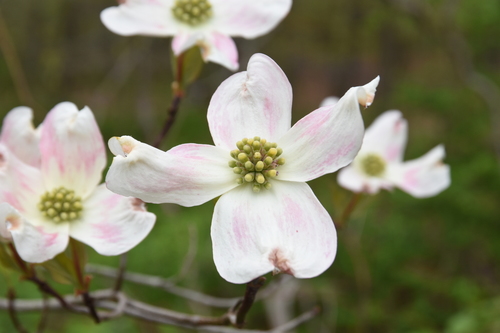
Dogwoods are characterized by their simple, opposite leaves with distinctive curved veins that run parallel to the margins. In spring, many species display large, colorful, petal-like structures called bracts—typically white, pink, or red—surrounding a tight central cluster of tiny, yellowish-green true flowers. In the fall, their foliage transforms into rich shades of burgundy and purple, complemented by clusters of bright red, blue, or white berries. The bark of mature trees often features a unique, deeply fissured pattern resembling alligator skin, comprised of small, squarish blocks.
カテゴリ
植物レア度
Common
危険度
1/5 · 非常に低い
スナップ
最初にスナップしよう!
Dogwood bark was historically boiled and used as a substitute for quinine to treat malaria and reduce fevers.
The name 'dogwood' likely evolved from 'dagwood,' referencing the extremely hard wood used to make sharp dags, skewers, and arrows.
The showy 'petals' of a flowering dogwood are actually modified leaves called bracts, which protect the cluster of true, tiny flowers in the center.
Dogwoods draw water from deep subterranean layers and release it into drier shallow soils during the night, assisting nearby plants.
They use large, highly colored modified leaves to mimic giant flowers, maximizing pollinator attraction while minimizing reproductive cost.
Their leaves accumulate calcium, decomposing much faster than other forest litter to rapidly enrich and sweeten the surrounding topsoil.
As autotrophic plants, dogwoods produce their own organic compounds via photosynthesis using sunlight, carbon dioxide, water, and minerals.
Bombycilla cedrorum
Migrating songbirds like Cedar Waxwings consume the lipid-rich berries to fuel their long journeys.
Odocoileus virginianus
White-tailed deer feed on the high-protein twigs, leaves, and buds, especially during lean winter months.
Antheraea polyphemus
The giant silk moth caterpillars feed on the leaves of dogwoods as one of their primary larval host plants.
このオブジェクトにはまだ特徴バッジが割り当てられていません。
まだ別名はありません。
テーマが追加されると、このオブジェクトのコレクションがここに表示されます。
危険度
1/5 · 非常に低い
まだ特別な安全上の注意はありません。
Dogwoodsを識別する最も簡単な方法は、Snappit自然識別アプリを使用することです。
10-1500 cm
30-120 年
As autotrophic plants, dogwoods produce their own organic compounds via photosynthesis using sunlight, carbon dioxide, water, and minerals.
Found in the understory of moist, well-drained deciduous forests, forest edges, riparian zones, and suburban landscapes.
Photosynthesis
ズームインしてクラスターを分割し、このオブジェクトが撮影された場所を探索しましょう。
新しい観察が追加されると、ここに最近のスナップが表示されます。