

Drooping Forked Fern
dicranopteris flexuosa
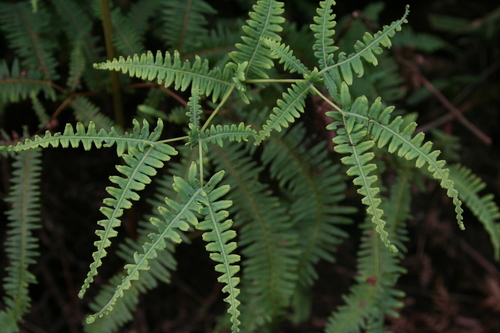
The Drooping Forked Fern (Dicranopteris flexuosa) is an elegant, scrambling fern renowned for its striking geometric growth. Characterized by its unique, repeatedly forking fronds, this hardy perennial often cascades down slopes or scrambles over neighboring vegetation, creating dense, emerald-green carpets in disturbed landscapes. It is a pioneer species, frequently found reclaiming bare soil, clay banks, and roadsides where other plants struggle to take root. This ancient fern lineage brings a prehistoric aesthetic to modern landscapes, showcasing evolutionary designs that have persisted for millions of years. Beyond its visual charm, the Drooping Forked Fern plays a vital ecological role by stabilizing loose soil, preventing erosion on steep banks, and providing shelter for small wildlife.
生息地: Found on open, sunny slopes, road cuts, forest edges, and disturbed areas with acidic, nutrient-poor soils.
This fern is easily identified by its distinctive pseudodichotomous branching pattern, where the fronds repeatedly split into 'Y' shapes. The pinnae are bright green to yellowish-green, deeply lobed, and have a soft, drooping appearance that gives the plant its common name. The main stems, or rachises, are tough, fibrous, and can scramble or climb, reaching lengths of up to 3 meters. Underneath the leaves, mature specimens display neat rows of circular, yellow-to-brown spore-producing structures called sori, which lack the protective covering found in many other fern species.
カテゴリ
植物レア度
Common
危険度
1/5 · 非常に低い
スナップ
最初にスナップしよう!
Its thick, dense mats can become so tightly woven that they inhibit the growth of invasive weeds, serving as a natural barrier in disturbed habitats.
This fern belongs to the Gleicheniaceae family, one of the oldest living lineages of ferns, with fossil records dating back to the Triassic period.
Unlike many ferns that prefer deep shade, the Drooping Forked Fern thrives in full sun and actually relies on high light levels to fuel its rapid, scrambling growth.
Its unique, repeatedly forking fronds allow it to scramble over adjacent vegetation and debris, maximizing sunlight capture in crowded forest edges.
Forms incredibly dense, interlocking underground rhizome networks and thick surface mats that hold loose, sandy, or clay soils firmly in place.
Thrives in highly acidic, aluminum-rich, and nutrient-depleted soils that would be toxic or uninhabitable for most other vascular plant species.
Like all ferns, this species is a photoautotroph that produces its own energy from sunlight, water, and carbon dioxide through photosynthesis.
年齢による違い: During its early gametophyte stage, it relies on a symbiotic relationship with mycorrhizal fungi for nutrients before developing independent photosynthetic fronds as a sporophyte.
Lygodium microphyllum
Competes for space and sunlight in Florida wetlands and pine flatwoods.
Anolis carolinensis
Uses the dense, tangled fronds of the fern for shelter and hunting insect prey.
Pinus palustris
Frequently associates with and competes for light in the understory of southern pine forests.
このオブジェクトにはまだ特徴バッジが割り当てられていません。
まだ別名はありません。
テーマが追加されると、このオブジェクトのコレクションがここに表示されます。
危険度
1/5 · 非常に低い
まだ特別な安全上の注意はありません。
Drooping Forked Fernを識別する最も簡単な方法は、Snappit自然識別アプリを使用することです。
50-300 cm
0.1-2 kg
5-15 年
Like all ferns, this species is a photoautotroph that produces its own energy from sunlight, water, and carbon dioxide through photosynthesis.
Found on open, sunny slopes, road cuts, forest edges, and disturbed areas with acidic, nutrient-poor soils.
Photosynthesis
ズームインしてクラスターを分割し、このオブジェクトが撮影された場所を探索しましょう。
新しい観察が追加されると、ここに最近のスナップが表示されます。



.jpg&width=800)















