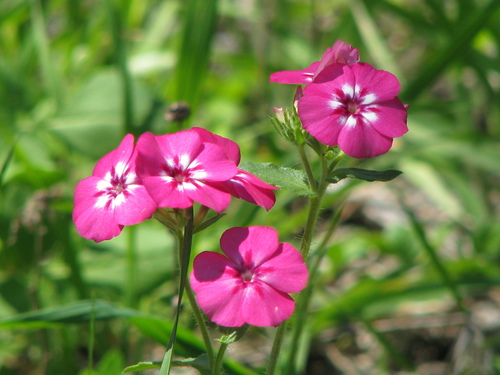


Drummond'S Phlox
phlox drummondii
Drummond's Phlox (Phlox drummondii) is a showy annual wildflower native to the sandy prairies, roadsides, and open woodlands of Texas. Named in honor of Scottish naturalist Thomas Drummond, who collected its seeds in 1835 and distributed them throughout Europe, this charming plant quickly captured the hearts of gardeners worldwide. Today, it is celebrated both as a hardy wild native and as a popular ornamental choice. Its ability to thrive in poor, sandy soils makes it a pioneer species of sorts, frequently painting barren roadsides in breathtaking sweeps of pink, red, and purple. Beyond its aesthetic appeal, Drummond's Phlox plays an important ecological role, offering a vital early-season nectar source for a variety of native pollinators, including butterflies, moths, and bees.
生息地: Typically found in sandy prairies, open post oak woodlands, pasture margins, and disturbed areas such as roadsides.
This species is a low-growing annual reaching heights of 15 to 50 centimeters. Its stems and lance-shaped leaves are covered in sticky, glandular hairs that deter crawling insects. The flowers are arranged in dense terminal clusters, with each blossom possessing five flat, star-like lobes (salverform corolla) fused into a narrow tube. The wild form typically displays rich rose-red or pink petals, often with a darker red or purple eye at the center, though cultivated varieties exhibit white, cream, lavender, and bi-colored blooms.
カテゴリ
植物レア度
Common
危険度
1/5 · 非常に低い
スナップ
最初にスナップしよう!
The genus name 'Phlox' is derived from the Greek word for flame, referring to the intense, fiery colors of the flowers.
This species is famous in evolutionary biology for showcasing 'character displacement,' where its flower color shifts from light blue to deep red when growing near a related blue-flowered phlox species to prevent cross-hybridization.
Thomas Drummond, the botanist who discovered this species, died in Cuba shortly after sending its seeds to Europe, never knowing how immensely popular his find would become.
The stems and leaves are covered in glandular, sticky hairs that trap and deter crawling pests from reaching the flowers.
The flowers feature ultraviolet patterns invisible to humans that guide insect pollinators directly to the nectar.
Its shallow, fibrous root system and sticky foliage help the plant conserve moisture and thrive in nutrient-poor, sandy soils.
As a photosynthetic plant, it produces its own energy by converting sunlight, water, and carbon dioxide into sugars.
Battus philenor
Pollinates the flowers while seeking nectar.
Danaus plexippus
Feeds on the nectar of the vibrant blossoms.
Odocoileus virginianus
Feeds on the foliage and tender stems of the plant.
このオブジェクトにはまだ特徴バッジが割り当てられていません。
まだ別名はありません。
テーマが追加されると、このオブジェクトのコレクションがここに表示されます。
危険度
1/5 · 非常に低い
まだ特別な安全上の注意はありません。
Drummond'S Phloxを識別する最も簡単な方法は、Snappit自然識別アプリを使用することです。
As a photosynthetic plant, it produces its own energy by converting sunlight, water, and carbon dioxide into sugars.
Typically found in sandy prairies, open post oak woodlands, pasture margins, and disturbed areas such as roadsides.
ズームインしてクラスターを分割し、このオブジェクトが撮影された場所を探索しましょう。
新しい観察が追加されると、ここに最近のスナップが表示されます。




.jpg&width=800)







