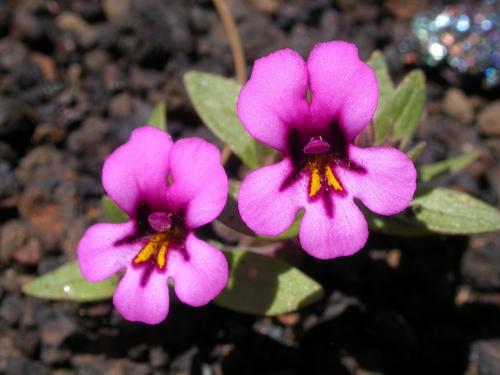


Dwarf Purple Monkeyflower
diplacus nanus
The Dwarf Purple Monkeyflower, Diplacus nanus, is a charming annual herbaceous plant known for its vibrant, funnel-shaped flowers. Native to western North America, this small but striking species adds a splash of color to rocky outcrops and open woodlands. Its adaptability to various dry, challenging environments makes it an interesting subject for botanists and nature enthusiasts alike. Despite its delicate appearance, Diplacus nanus is remarkably resilient, thriving in conditions where many other plants struggle, and often forming colorful carpets across barren landscapes during its bloom season.
生息地: Found in open, rocky or gravelly areas, disturbed sites, and dry to moist woodlands, often at higher elevations.
This low-growing annual typically reaches heights of 5-20 cm. Its stems are often reddish-purple, branching and covered in fine hairs. The leaves are small, narrow, and often somewhat hairy, arranged oppositely along the stem. The most distinctive feature is its brilliant purple to magenta flowers, which are tubular with five broad, flaring lobes, often appearing in profusion at the stem tips. Each flower typically measures 1-2 cm across and may have subtle darker markings in the throat.
カテゴリ
植物レア度
Common
危険度
1/5 · 非常に低い
スナップ
最初にスナップしよう!
Despite being an annual, it can produce a large number of seeds, allowing it to rapidly colonize disturbed areas.
Its vibrant purple color is particularly effective at attracting native bees, which are its primary pollinators.
The common name 'monkeyflower' comes from the perceived resemblance of the flower's face to a monkey's face.
The genus Diplacus was formerly included within Mimulus, but recent genetic studies have reclassified many species, including this one.
This plant is well-adapted to arid conditions, capable of surviving prolonged dry spells by efficiently utilizing available moisture and often completing its life cycle rapidly.
Diplacus nanus thrives in nutrient-poor, rocky or gravelly soils, where its root system can anchor effectively and extract limited resources.
Its vivid purple flowers serve as a strong visual signal to a range of pollinators, primarily bees, ensuring successful reproduction in its often isolated habitats.
As an autotrophic plant, the Dwarf Purple Monkeyflower produces its own food through photosynthesis, converting sunlight, water, and carbon dioxide into sugars for energy and growth.
Bombus spp.
Pollinates flowers
Andrena spp.
Pollinates flowers
Odocoileus spp.
Herbivore, consumes plant tissue
Pinus ponderosa
Grows in association with
このオブジェクトにはまだ特徴バッジが割り当てられていません。
まだ別名はありません。
テーマが追加されると、このオブジェクトのコレクションがここに表示されます。
危険度
1/5 · 非常に低い
まだ特別な安全上の注意はありません。
Dwarf Purple Monkeyflowerを識別する最も簡単な方法は、Snappit自然識別アプリを使用することです。
5-20 cm
0.001-0.01 kg
1 年
As an autotrophic plant, the Dwarf Purple Monkeyflower produces its own food through photosynthesis, converting sunlight, water, and carbon dioxide into sugars for energy and growth.
Found in open, rocky or gravelly areas, disturbed sites, and dry to moist woodlands, often at higher elevations.
ズームインしてクラスターを分割し、このオブジェクトが撮影された場所を探索しましょう。
新しい観察が追加されると、ここに最近のスナップが表示されます。