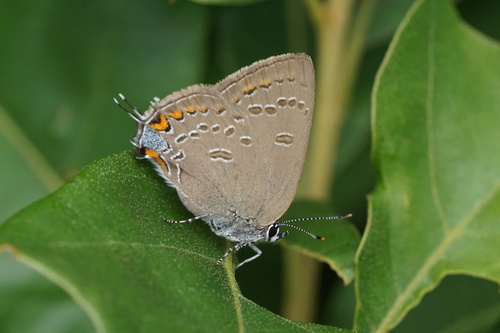


Edwards' Hairstreak
satyrium edwardsii
Edwards' Hairstreak (Satyrium edwardsii) is a rare and captivating butterfly native to eastern North America, prized by insect enthusiasts for its fascinating life history and habitat specificity. Belonging to the gossamer-winged butterfly family, this small insect is closely tied to oak barrens, savannas, and sandy pine-oak barrens. What makes this butterfly truly remarkable is its obligate mutualistic relationship with Allegheny mound ants. The ants build protective shelters around the butterfly pupae at the base of oak trees and guard the caterpillars from predators. In exchange, the caterpillars provide the ants with a sweet, nutrient-rich sugary secretion called honeydew. This delicate ecological dance highlights the complex dependencies within vanishing oak savanna ecosystems, making the Edwards' Hairstreak an important indicator species for habitat health.
生息地: Typically found in sandy oak barrens, oak savannas, and rocky ridges containing scrub oak species.
This small butterfly has a wingspan of 2.5 to 3.2 centimeters. The underside of its wings is a soft, earthy gray-brown, decorated with a neat row of dark oval spots finely edged in white. Near the outer margin of the hindwing, there is a striking, bright blue patch adjacent to an orange crescent, which serves to distract predators. A fine, hair-like tail extends from the edge of each hindwing, mimicking antennae to create a false head effect. The upperside of the wings, rarely seen when perched, is a uniform dark brown.
カテゴリ
昆虫レア度
Common
危険度
1/5 · 非常に低い
スナップ
最初にスナップしよう!
The ants that guard the caterpillars actually construct soil shelters or tents over the pupae at the base of oak trees to protect them.
The false head on its hindwings is so convincing that jumping spiders and other predators are frequently tricked into biting the harmless wing tails instead of the actual body.
This butterfly has a single generation per year, spending more than half its life cycle inside a tiny egg shell during the winter months.
Larvae secrete sweet honeydew from specialized glands to attract protector ants, which guard them from predators and parasites.
The butterfly uses slender tail-like appendages and bright eyespots on its hindwings to mimic a head, tricking predators into attacking non-vital wing areas.
The species survives freezing winters in the egg stage, safely glued to the twigs of host oak trees until the spring budburst.
Larvae feed exclusively on the tender young leaves of specific oak trees, while adults consume flower nectar.
年齢による違い: Caterpillars consume foliage of host oak trees, whereas adult butterflies transition to nectar feeding on various wildflowers.
Quercus ilicifolia
Larvae feed exclusively on the leaves of this host plant.
Formica exsectoides
Ants protect the larvae and pupae from predators in exchange for honeydew.
Asclepias tuberosa
Adult butterflies feed on nectar from the blossoms of this wildflower.
このオブジェクトにはまだ特徴バッジが割り当てられていません。
まだ別名はありません。
テーマが追加されると、このオブジェクトのコレクションがここに表示されます。
危険度
1/5 · 非常に低い
まだ特別な安全上の注意はありません。
Edwards' Hairstreakを識別する最も簡単な方法は、Snappit自然識別アプリを使用することです。
0.0001+ kg
12 km/h
Larvae feed exclusively on the tender young leaves of specific oak trees, while adults consume flower nectar.
Typically found in sandy oak barrens, oak savannas, and rocky ridges containing scrub oak species.
Grazing
ズームインしてクラスターを分割し、このオブジェクトが撮影された場所を探索しましょう。
新しい観察が追加されると、ここに最近のスナップが表示されます。













