

Emaravirus
emaravirus
Emaraviruses are a unique and fascinating genus of plant-infecting RNA viruses belonging to the family Fimoviridae. These microscopic pathogens are distinct for their multipartite genomes, meaning their genetic blueprint is divided into several separate segments of single-stranded RNA. Unlike many other plant viruses, emaraviruses cannot easily spread on their own or through mechanical contact. Instead, they rely on a highly specialized relationship with microscopic eriophyid mites, which act as specific vectors to carry them from host to host. Emaraviruses are responsible for causing several notable agricultural and ecological plant diseases globally.
生息地: Typically found inside the vascular tissue and cells of host plants, as well as within the bodies of their specialized eriophyid mite vectors.
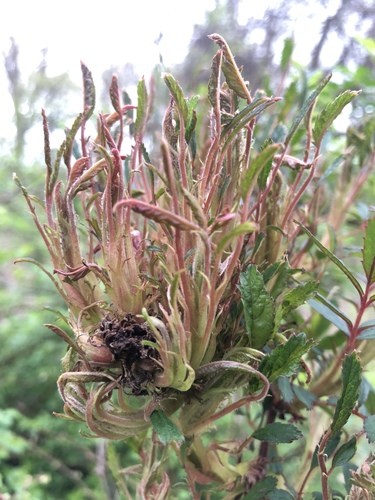
Because emaraviruses are microscopic virions measuring only 80 to 100 nanometers in diameter, they cannot be seen directly with the naked eye. Spotters can instead identify their presence by the distinctive symptoms they produce on infected host plants. These symptoms include striking yellow ringspots, mosaic patterns on leaves, leaf distortion, and 'witches' broom'—an abnormal, dense bunching of twigs and branches that resembles a broom. On roses, an infection often causes a bright red discoloration of leaves and stems and a proliferation of unusually soft, thick thorns.
カテゴリ
Animalレア度
Common
危険度
1/5 · 非常に低い
スナップ
最初にスナップしよう!
Eriophyid mites can carry the virus within their gut and salivary glands, passing it on to new leaves as they feed.
The genus name 'Emaravirus' is an acronym derived from the first identified species: European mountain ash ringspot-associated virus (EMARAV).
Unlike many viruses with simple genetic strands, emaraviruses have a highly complex, fragmented genome split into up to eight separate envelopes.
Exploits microscopic, four-legged eriophyid mites to achieve highly specific transport and transmission from plant to plant.
Utilizes a multipartite RNA structure of four to eight segments, allowing the virus to easily adapt and rapidly evolve.
Successfully hijacks the plant host's translation machinery to produce viral proteins, bypassing the plant's immune defenses.
Emaraviruses do not consume physical food; instead, they replicate by extracting metabolic resources and cellular machinery directly from infected plant cells.
Phyllocoptes fructiphilus
Uses this microscopic mite as a highly specific vector to transmit the Rose Rosette Virus to host rose bushes.
Sorbus aucuparia
Serves as a major host plant for the European Mountain Ash Ringspot-Associated Virus, leading to leaf chlorosis.
Rosa multiflora
Infects this invasive rose species, causing rapid stem elongation and leaf distortion.
このオブジェクトにはまだ特徴バッジが割り当てられていません。
まだ別名はありません。
テーマが追加されると、このオブジェクトのコレクションがここに表示されます。
危険度
1/5 · 非常に低い
まだ特別な安全上の注意はありません。
Emaravirusを識別する最も簡単な方法は、Snappit自然識別アプリを使用することです。
Emaraviruses do not consume physical food; instead, they replicate by extracting metabolic resources and cellular machinery directly from infected plant cells.
Typically found inside the vascular tissue and cells of host plants, as well as within the bodies of their specialized eriophyid mite vectors.
Parasitic Cell Invasion
ズームインしてクラスターを分割し、このオブジェクトが撮影された場所を探索しましょう。
新しい観察が追加されると、ここに最近のスナップが表示されます。



