

European Globeflower
trollius europaeus
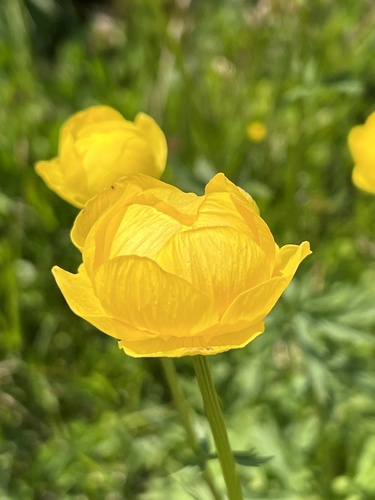
The European Globeflower, Trollius europaeus, is a charming perennial herb native to Europe and Western Asia, recognized for its distinctive, buttercup-like flowers. Its common name, 'globeflower', aptly describes the spherical shape of its bright yellow blossoms, which remain tightly closed or slightly open at the top. This unique floral structure plays a crucial role in its specialized pollination strategy. A member of the Ranunculaceae family, it thrives in damp, grassy environments, bringing a splash of golden yellow to meadows and stream banks during late spring and early summer. Despite its delicate appearance, it is a robust plant, often forming impressive colonies in suitable conditions.
生息地: The European Globeflower thrives in damp, nutrient-rich habitats such as wet meadows, fens, marshes, stream banks, and damp open woodlands.
The European Globeflower is characterized by its vivid, lemon-yellow to deep yellow, globe-shaped flowers, typically 2-3 cm in diameter. These flowers are unique in that the sepals form an enclosing 'globe' around the petals and reproductive organs. It grows on erect, sparsely branched stems, reaching heights of 30 to 80 cm. The leaves are deeply lobed and serrated, mainly basal, with a few smaller leaves appearing alternately along the stem. The overall appearance is a sturdy, upright plant crowned with multiple orb-like blooms.
カテゴリ
植物レア度
Common
危険度
1/5 · 非常に低い
スナップ
最初にスナップしよう!
Despite its toxicity to some animals, its leaves and flowers were historically used in folk medicine, though caution was always advised due to its potent compounds.
In folklore, globeflowers were sometimes associated with magical properties and were believed to bring good fortune, particularly when found in wild meadows.
Its name 'Trollius' is thought to derive from the German word 'Trollblume' (troll flower) or from the old Norse 'troll', meaning something round and magical.
The unique, tightly closed globe shape of its flower provides a protective nursery for the larvae of the tiny globeflower fly, which is its primary pollinator.
It has a mutualistic relationship with a specific group of flies (Chiastocheta species), which are the only insects small enough to enter the tightly closed flower to pollinate it, while also laying their eggs within the flower.
This species is well-adapted to cooler temperate climates, capable of tolerating cold winters and often found in montane or subalpine regions across its range.
Like many members of the buttercup family, the European Globeflower contains toxic compounds, primarily protoanemonin, which deters most grazing herbivores from consuming it.
As a photosynthetic plant, the European Globeflower produces its own food by converting light energy into chemical energy. It absorbs water and essential minerals from the soil and carbon dioxide from the atmosphere.
Chiastocheta trollii
Primary pollinator, lays eggs inside the flower
Capreolus capreolus
Potential herbivore, though deterred by toxicity
Various species
Soil fungi forming symbiotic root associations
Bos taurus
Grazing animal that may inadvertently spread seeds or trample plants
このオブジェクトにはまだ特徴バッジが割り当てられていません。
まだ別名はありません。
テーマが追加されると、このオブジェクトのコレクションがここに表示されます。
危険度
1/5 · 非常に低い
まだ特別な安全上の注意はありません。
European Globeflowerを識別する最も簡単な方法は、Snappit自然識別アプリを使用することです。
30-80 cm
0.02-0.1 kg
3-10 年
As a photosynthetic plant, the European Globeflower produces its own food by converting light energy into chemical energy. It absorbs water and essential minerals from the soil and carbon dioxide from the atmosphere.
The European Globeflower thrives in damp, nutrient-rich habitats such as wet meadows, fens, marshes, stream banks, and damp open woodlands.
Photosynthesis And Nutrient Absorption
ズームインしてクラスターを分割し、このオブジェクトが撮影された場所を探索しましょう。
新しい観察が追加されると、ここに最近のスナップが表示されます。












