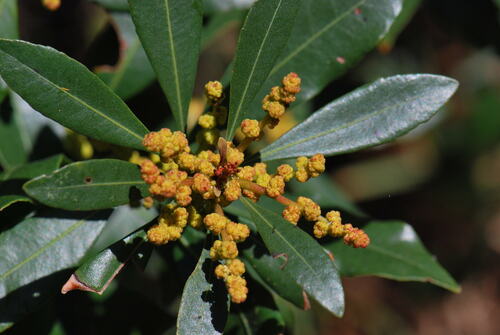


Faya Bayberry
morella faya
The Faya Bayberry, "Morella faya", is a remarkable evergreen shrub or small tree native to the Macaronesian islands. This resilient plant is particularly interesting due to its unique ecological role: it's a nitrogen fixer, capable of enriching the soil around it, thereby supporting a diverse array of life in its native habitats. Its small, edible, berry-like fruits are a food source for birds, which in turn aid in seed dispersal. While a valued component of its natural ecosystem, its exceptional adaptability and prolific seed production have unfortunately made it an aggressive invasive species in other regions, most notably in Hawaii, where it profoundly alters native forest ecosystems by outcompeting indigenous flora and significantly changing soil nutrient dynamics. Understanding this dual nature is key to appreciating its complex impact on global biodiversity.
生息地: In its native range, Faya Bayberry is found in laurisilva forests, coastal scrub, and disturbed areas, while as an invasive species, it thrives in a wide range of environments including rainforests, montane wet forests, and even pastures.
This plant typically grows as a multi-stemmed shrub or a small tree, reaching heights of 3 to 10 meters. Its leaves are glossy, dark green, somewhat leathery, lance-shaped, and arranged alternately on the branches. The bark is smooth and grayish when young, becoming rougher and more furrowed with age. Small, reddish-brown, waxy, berry-like fruits, about 5-8 mm in diameter, are borne in dense clusters in the leaf axils, ripening from green to a dark purplish-black.
カテゴリ
植物レア度
Common
危険度
1/5 · 非常に低い
スナップ
最初にスナップしよう!
Invasive Faya Bayberry in Hawaii can increase nitrogen levels in the soil by up to four times, drastically altering nutrient cycling and favoring non-native plants.
Its ability to fix nitrogen allows it to colonize nutrient-poor volcanic soils, giving it a strong advantage over native species in places like the Hawaiian Islands.
The common name "Faya" is derived from its Portuguese name "Faia das Ilhas" (Island Beech), though it is not a true beech.
The fruits of Faya Bayberry are edible and have been traditionally used to make a type of wine or jam in its native Macaronesian islands.
Faya Bayberry forms a symbiotic relationship with "Frankia" bacteria in its root nodules, allowing it to fix atmospheric nitrogen. This enriches the soil, giving it a competitive advantage, especially in nutrient-poor environments.
The species exhibits a notable ability to withstand periods of low water availability, making it resilient in various climatic conditions and aiding its spread in new territories.
It produces abundant, small, fleshy fruits that are highly attractive to birds, facilitating wide and efficient seed dispersal across landscapes.
Faya Bayberry produces its own energy through photosynthesis, converting sunlight into sugars. It also benefits from a symbiotic relationship with soil bacteria that fix atmospheric nitrogen, enhancing nutrient availability in the soil.
Myadestes obscurus
Birds consume the fruits and disperse seeds widely, contributing to the plant's spread in both native and introduced ranges.
Frankia spp.
Faya Bayberry forms a crucial symbiotic association with these bacteria, which colonize its roots and convert atmospheric nitrogen into a usable form.
Metrosideros polymorpha
As an invasive species in Hawaii, Faya Bayberry outcompetes native trees like 'Ōhi'a Lehua, leading to a decline in biodiversity.
Parabemisia myricae
Various insect species feed on Faya Bayberry, acting as herbivores and in some cases, contributing to natural control in its native range.
このオブジェクトにはまだ特徴バッジが割り当てられていません。
まだ別名はありません。
テーマが追加されると、このオブジェクトのコレクションがここに表示されます。
危険度
1/5 · 非常に低い
まだ特別な安全上の注意はありません。
Faya Bayberryを識別する最も簡単な方法は、Snappit自然識別アプリを使用することです。
300-1000 cm
20-100 kg
50-150 年
Faya Bayberry produces its own energy through photosynthesis, converting sunlight into sugars. It also benefits from a symbiotic relationship with soil bacteria that fix atmospheric nitrogen, enhancing nutrient availability in the soil.
In its native range, Faya Bayberry is found in laurisilva forests, coastal scrub, and disturbed areas, while as an invasive species, it thrives in a wide range of environments including rainforests, montane wet forests, and even pastures.
Photosynthesis, Nutrient Absorption
ズームインしてクラスターを分割し、このオブジェクトが撮影された場所を探索しましょう。
新しい観察が追加されると、ここに最近のスナップが表示されます。