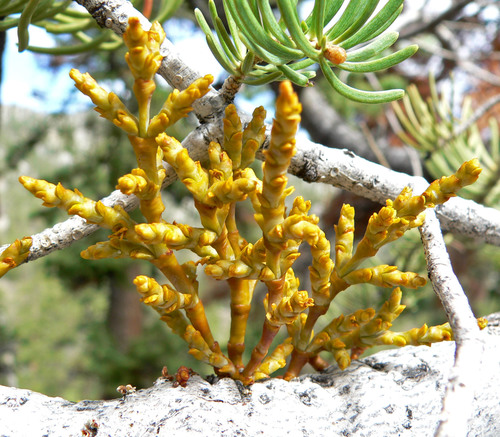


Fir Dwarf-Mistletoe
arceuthobium abietinum
The Fir Dwarf-Mistletoe (Arceuthobium abietinum) is a highly specialized parasitic plant found high in the canopies of western North American coniferous forests. Lacking true leaves and functional roots, this intriguing organism relies almost entirely on its host trees for survival. It target-parasitizes true firs, absorbing water and nutrients from their vascular systems. While often regarded as a forest pathogen because it drains host resources and deforms tree growth, it plays an indispensable ecological role. The dense, tangled branch structures called witch's brooms that it induces provide essential nesting sites and shelter for a variety of woodland birds and mammals, making this plant a keystone species in its native ecosystems.
生息地: Typically found in mature coniferous forests of western North America, growing parasitically on the branches of true fir trees.
This species is recognizable by its small, scale-like, jointed stems that lack true leaves, protruding directly from the bark of infected fir branches. These yellow-green, olive-green, or brownish-orange shoots usually grow only 5 to 15 centimeters in height. In summer, they yield tiny, inconspicuous greenish flowers. The resulting fruit is a small, fleshy, oval berry that hangs downward, eventually swelling as it ripens before audibly bursting to eject its sticky seed.
カテゴリ
植物レア度
Common
危険度
1/5 · 非常に低い
スナップ
最初にスナップしよう!
Dwarf-mistletoe seeds are coated in a sticky substance called viscin, which acts like natural superglue to help them stick to pine needles and branches upon impact.
The dense branch clusters or 'witch's brooms' generated by this parasite provide critical nesting habitats for rare forest species like the Spotted Owl.
The seeds are literally jet-propelled, shooting out of their seed coats using built-in water pressure to launch at speeds exceeding highway driving limits.
Builds up high internal hydrostatic pressure to audibly shoot seeds at speeds of up to 90 kilometers per hour, launching them up to 15 meters away to find new host branches.
Manipulates the host tree's growth hormones, causing the branch to grow into a dense, nested cluster of twigs that acts as a concentrated nutrient sink for the parasite.
Uses a root-like system called a haustorium to penetrate host bark, seamlessly tapping into the tree's xylem and phloem to extract water, minerals, and carbon.
Absorbs water, minerals, and photosynthetic carbohydrates directly from the host tree's vascular tissue.
Abies concolor
Acts as a primary host tree, providing water and essential nutrients to the parasite.
Abies magnifica
Acts as a host tree in high-altitude zones, supporting populations of the parasite.
Callophrys spinetorum
The larvae of this butterfly feed exclusively on dwarf-mistletoe shoots.
このオブジェクトにはまだ特徴バッジが割り当てられていません。
まだ別名はありません。
テーマが追加されると、このオブジェクトのコレクションがここに表示されます。
危険度
1/5 · 非常に低い
まだ特別な安全上の注意はありません。
Fir Dwarf-Mistletoeを識別する最も簡単な方法は、Snappit自然識別アプリを使用することです。
5-15 cm
0.01-0.08 kg
5-20 年
Absorbs water, minerals, and photosynthetic carbohydrates directly from the host tree's vascular tissue.
Typically found in mature coniferous forests of western North America, growing parasitically on the branches of true fir trees.
Parasitism
ズームインしてクラスターを分割し、このオブジェクトが撮影された場所を探索しましょう。
新しい観察が追加されると、ここに最近のスナップが表示されます。













_Symphoricarpos_albus_-_Fruits_and_foliage_-_Les_Martels%2C_Giroussens_Tarn.jpg&width=800)


