

Flame Chub
hemitremia flammea
The Flame Chub (Hemitremia flammea) is a captivating freshwater fish native to the southeastern United States, known for the brilliant red-orange coloration displayed by males during breeding season. This small but vibrant member of the minnow family thrives in clear, cool streams and springs, often indicating good water quality in its habitat. Its ecological role as both a consumer of small invertebrates and a prey item for larger fish highlights its importance within stream ecosystems. Despite its striking appearance, the Flame Chub is relatively shy, making it a prized sighting for aquatic enthusiasts and an important species for conservation efforts focused on preserving pristine headwater environments.
生息地: Found predominantly in clear, cool, relatively swift-flowing small to medium-sized streams, creeks, and spring runs with gravel, rubble, or bedrock substrates, often associated with woody debris.
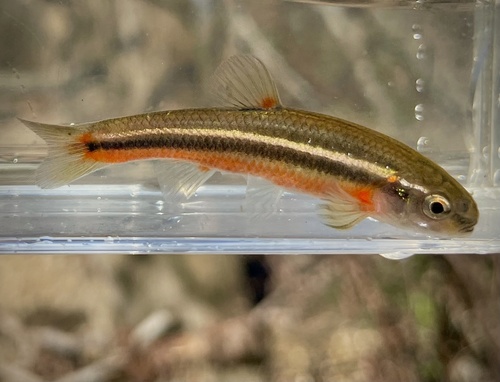
The Flame Chub is a small, slender fish typically growing 5 to 9 cm in length. Its body is generally silvery-tan to olive-brown on the back, fading to a lighter, silvery belly. A distinct dark lateral stripe runs from the snout through the eye to the base of the caudal fin. During the breeding season, males exhibit spectacular coloration, with the lower sides, belly, and fins (especially the caudal and anal fins) developing an intense flame-like orange-red hue. Tubercles, small nuptial bumps, may also appear on the heads of breeding males. The fins are typically clear to yellowish, with a dark spot often present at the base of the caudal fin.
カテゴリ
魚類レア度
Common
危険度
1/5 · 非常に低い
スナップ
最初にスナップしよう!
Despite their small size, their vibrant breeding colors make them one of the most visually striking minnow species in their range.
Flame Chubs are a "coolwater" species, meaning they thrive in water temperatures below 20-22°C (68-72°F) and are sensitive to thermal pollution.
The scientific name "flammea" directly refers to the fiery red coloration observed in breeding males.
They are "nest associates," meaning they sometimes lay their eggs in the nests of other fish, such as creek chubs or hornyhead chubs, which then inadvertently guard the Flame Chub eggs.
Breeding male Flame Chubs develop vivid red-orange coloration on their lower sides and fins, making them highly conspicuous to attract mates during reproduction.
Their strong preference for and reliance on pristine, cool, and oxygenated water makes their presence a natural indicator of good stream health and minimal pollution.
With a small, subterminal mouth, they are adept at picking minute food items, such as insect larvae and algae, from the cracks and surfaces of rocks and gravel on the stream bottom.
Flame Chubs primarily consume small aquatic invertebrates, particularly insect larvae, supplemented with diatoms and other plant material scraped from the substrate.
Micropterus dolomieu
Common predator in its habitat.
Ephemeroptera spp.
Main food source for the chub.
Nerodia sipedon
Common predator of small fish in streams.
Cottus bairdi
Competes for similar food resources in shared habitats.
このオブジェクトにはまだ特徴バッジが割り当てられていません。
まだ別名はありません。
テーマが追加されると、このオブジェクトのコレクションがここに表示されます。
危険度
1/5 · 非常に低い
まだ特別な安全上の注意はありません。
Flame Chubを識別する最も簡単な方法は、Snappit自然識別アプリを使用することです。
5-9 cm
0.005-0.015 kg
2-4 年
10 km/h
Flame Chubs primarily consume small aquatic invertebrates, particularly insect larvae, supplemented with diatoms and other plant material scraped from the substrate.
Found predominantly in clear, cool, relatively swift-flowing small to medium-sized streams, creeks, and spring runs with gravel, rubble, or bedrock substrates, often associated with woody debris.
Foraging
ズームインしてクラスターを分割し、このオブジェクトが撮影された場所を探索しましょう。
新しい観察が追加されると、ここに最近のスナップが表示されます。


















