

Flat Floater
utterbackiana suborbiculata
The Flat Floater (Utterbackiana suborbiculata) is a remarkably large and distinct freshwater mussel native to the quiet, muddy waters of North America. Known for its exceptionally flat, circular shell and thin, delicate structure, this bivalve is uniquely adapted to environments that would suffocate other mussel species. By spreading its weight across a wide surface area, it effectively floats on top of soft, unstable silt and mud bottoms. As ecosystem engineers, Flat Floaters play a vital role in maintaining aquatic health. Through continuous filter feeding, they clarify water, cycle nutrients, and provide microhabitats for benthic microorganisms, making them quiet champions of lake and river conservation.
生息地: Found in quiet, slow-moving waters such as oxbow lakes, muddy ponds, and river sloughs with soft silt or mud substrates.
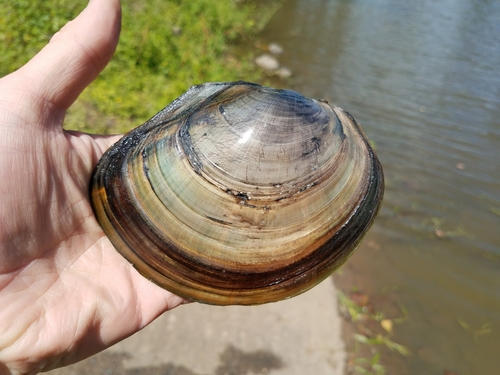
This mussel is easily recognized by its nearly circular, heavily compressed shell that can reach up to 18 centimeters in length. The shell is remarkably thin and fragile compared to other unionids. Its outer surface is typically a light yellowish-green to dark brown, often featuring fine green rays in younger specimens. Internally, the shell boasts a pearly, iridescent nacre that ranges from silvery-white to pinkish-orange, lacking well-developed hinge teeth.
カテゴリ
Invertebrateレア度
Common
危険度
1/5 · 非常に低い
スナップ
最初にスナップしよう!
Its scientific name 'suborbiculata' directly translates to 'nearly circular', referring to its unique, disc-like shape.
The flat floater's shell is so incredibly thin and fragile that dry shells can often be crushed easily with light finger pressure.
Unlike most mussels that require clean gravel, this species prefers thick, gooey mud, earning its reputation as a true mud-dweller.
An extremely thin, lightweight, and broad shell allows the mussel to rest on soft, deep silt without sinking.
Its larvae attach to the fins or gills of specific host fish to safely disperse throughout aquatic systems.
It can survive in low-oxygen, stagnant water conditions that would be fatal to most other freshwater mussels.
Filters microscopic organic debris, algae, and bacteria directly from the slow-moving water column using its specialized gills.
Lepomis macrochirus
Serves as a host for the larval stage (glochidia) of the Flat Floater.
Ondatra zibethicus
Preys on the adult mussels, leaving piles of empty shells along the banks.
このオブジェクトにはまだ特徴バッジが割り当てられていません。
まだ別名はありません。
テーマが追加されると、このオブジェクトのコレクションがここに表示されます。
危険度
1/5 · 非常に低い
まだ特別な安全上の注意はありません。
Flat Floaterを識別する最も簡単な方法は、Snappit自然識別アプリを使用することです。
10+ cm
0.1+ kg
5+ 年
Filters microscopic organic debris, algae, and bacteria directly from the slow-moving water column using its specialized gills.
Found in quiet, slow-moving waters such as oxbow lakes, muddy ponds, and river sloughs with soft silt or mud substrates.
Filtering
50000+
ズームインしてクラスターを分割し、このオブジェクトが撮影された場所を探索しましょう。
新しい観察が追加されると、ここに最近のスナップが表示されます。
















