

Fourpoint Evening Primrose
oenothera rhombipetala
The Fourpoint Evening Primrose is a striking biennial or annual wildflower native to the sandy regions of the central United States. It stands out in its native habitats due to its tall, erect spikes covered in numerous bright yellow flowers. Like other members of the evening primrose family, this plant plays a crucial ecological role by opening its blossoms late in the day, providing an essential nectar source for nocturnal and crepuscular insects, especially sphinx moths. Its ability to colonize nutrient-poor, sandy soils makes it a vital pioneer species that helps stabilize loose soil and prevent erosion.
生息地: Typically found in sandy soils, sand prairies, open dunes, disturbed roadsides, and waste areas of the central United States.
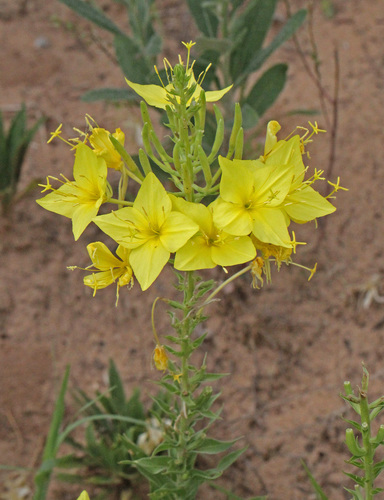
This species typically grows as a single, hairy stem rising up to 100 centimeters. It features lance-shaped, greyish-green leaves that are lightly covered in fine hairs. The defining feature is the terminal spike of flowers, where each blossom displays four distinct, bright yellow petals that are noticeably diamond-shaped (rhombic) and taper to a point. The flowers open progressively from the bottom of the spike upward, accompanied by long, narrow floral bracts.
カテゴリ
植物レア度
Common
危険度
1/5 · 非常に低い
スナップ
最初にスナップしよう!
Because it thrives in nutrient-poor sand, it is frequently used in ecological restoration projects to stabilize soils and initiate plant succession on degraded land.
The specific epithet 'rhombipetala' is a direct reference to the unique, diamond-like rhombic shape of its four yellow petals.
Unlike many plants that open flowers imperceptibly, the blossoms of this species can sometimes be observed unfolding in real-time at dusk within just a few minutes.
Opens its yellow blossoms rapidly at dusk to target nocturnal pollinators, such as hawkmoths, avoiding daytime nectar thieves.
Possesses a deep, robust taproot and specialized hairy foliage that allow it to anchor and thrive in dry, shifting sand dunes.
Produces seeds that can remain dormant in sandy soil seed banks for multiple years until ideal moisture and light levels occur.
As a photosynthetic autotroph, this plant synthesizes its own organic compounds using sunlight, water, carbon dioxide, and essential soil minerals.
Schinia florida
The caterpillar of this moth feeds directly on the developing flowers and seed pods of the primrose.
Hyles lineata
This large moth is a key nocturnal pollinator, drinking nectar from the freshly opened evening flowers.
Apis mellifera
Visits the flowers during the early morning hours before they wither in the midday heat, collecting remaining pollen.
このオブジェクトにはまだ特徴バッジが割り当てられていません。
まだ別名はありません。
テーマが追加されると、このオブジェクトのコレクションがここに表示されます。
危険度
1/5 · 非常に低い
まだ特別な安全上の注意はありません。
Fourpoint Evening Primroseを識別する最も簡単な方法は、Snappit自然識別アプリを使用することです。
30-100 cm
1-2 年
As a photosynthetic autotroph, this plant synthesizes its own organic compounds using sunlight, water, carbon dioxide, and essential soil minerals.
Typically found in sandy soils, sand prairies, open dunes, disturbed roadsides, and waste areas of the central United States.
Photosynthesis
ズームインしてクラスターを分割し、このオブジェクトが撮影された場所を探索しましょう。
新しい観察が追加されると、ここに最近のスナップが表示されます。




_(6804020555).jpg&width=800)












