

FréMont'S Phacelia
phacelia fremontii
Fremont's phacelia (Phacelia fremontii) is a delightful, low-growing annual wildflower native to the arid desert regions of the Southwestern United States. Adorning the desert floor during spring, this resilient plant is celebrated for its vibrant displays that transform sandy wastes into colorful carpets. It typically emerges following sufficient winter rainfall, completing its entire life cycle in a brief, spectacular window before the harsh summer heat sets in. Historically named after the explorer John C. Fremont, this species plays a vital ecological role by serving as an early-season nectar source for desert bees, butterflies, and other pollinators.
生息地: Found in sandy or gravelly desert flats, washes, and slopes, often associated with creosote scrub, Joshua tree woodlands, and pinyon-juniper communities.
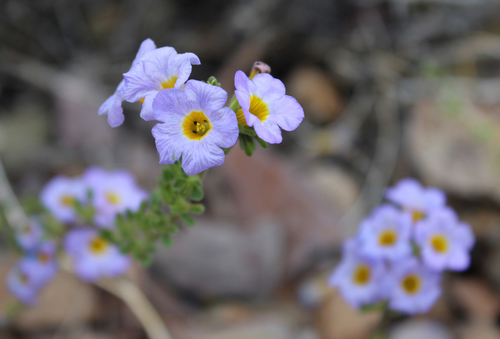
This species is easily recognized by its small, bell-shaped flowers, which feature a striking color gradient consisting of five bright blue-violet to lavender lobes surrounding a brilliant yellow throat. The plant grows close to the ground, usually reaching heights of 5 to 30 centimeters, with fleshy, deeply lobed leaves that form a rosette at the base. The entire plant, especially the flowering stems, is covered in fine, sticky glandular hairs that catch the light and give it a glistening, textured appearance.
カテゴリ
植物レア度
Common
危険度
1/5 · 非常に低い
スナップ
最初にスナップしよう!
Fremont's phacelia is also commonly known as the yellow-throated phacelia due to the bright yellow center that contrasts beautifully with its violet petals.
Like many members of the borage family, it has coiled flower heads that slowly unfurl like a scorpion's tail as the blooms open.
The seeds of this plant require a cold period followed by moisture to break dormancy, ensuring they only sprout during the favorable spring season.
The seeds can remain dormant in dry soil for years, germinating rapidly only when winter rainfall is sufficient to guarantee survival.
Covered in viscid hairs that deter crawling insects, reduce moisture loss, and protect the plant from intense solar radiation.
Features highly contrasting yellow throats against purple petals, serving as a visual target that guides native pollinators directly to the nectar.
As an autotrophic plant, Fremont's phacelia produces its own food through photosynthesis using sunlight, water, carbon dioxide, and soil nutrients.
Habropoda pallida
Provides early-season nectar and pollen to specialized desert bees.
Gopherus agassizii
The succulent leaves and flowers are consumed as seasonal forage.
Brassica tournefortii
Competes directly for soil moisture and space with invasive annual desert plants.
このオブジェクトにはまだ特徴バッジが割り当てられていません。
まだ別名はありません。
テーマが追加されると、このオブジェクトのコレクションがここに表示されます。
危険度
1/5 · 非常に低い
まだ特別な安全上の注意はありません。
FréMont'S Phaceliaを識別する最も簡単な方法は、Snappit自然識別アプリを使用することです。
5-30 cm
最大 1 年
As an autotrophic plant, Fremont's phacelia produces its own food through photosynthesis using sunlight, water, carbon dioxide, and soil nutrients.
Found in sandy or gravelly desert flats, washes, and slopes, often associated with creosote scrub, Joshua tree woodlands, and pinyon-juniper communities.
ズームインしてクラスターを分割し、このオブジェクトが撮影された場所を探索しましょう。
新しい観察が追加されると、ここに最近のスナップが表示されます。














.jpg&width=800)