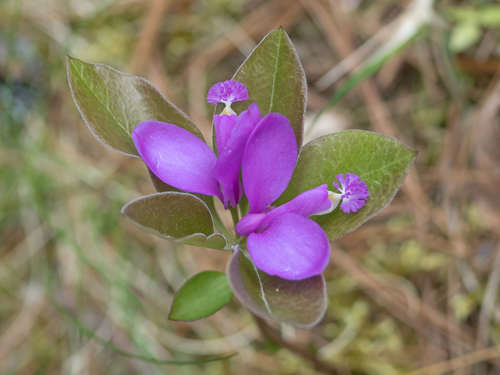


Fringed Polygala
polygaloides paucifolia
Fringed Polygala, also known as gaywings or flowering wintergreen, is a captivating perennial wildflower native to the woodlands of eastern North America. Rising only a few inches above the forest floor, this charming plant is famous for its stunning orchid-like blossoms that resemble tiny pink-purple airplanes or birds in flight. It belongs to the milkwort family rather than the orchid family, showing a remarkable example of convergent evolution. The plant is particularly unique because it employs a dual-reproduction strategy, producing both showy, insect-pollinated flowers above ground and inconspicuous, self-pollinating flowers near or below the soil surface. This ensures reproductive success even in deep, shaded woodlands where pollinating insects might be scarce. For hikers and nature enthusiasts, spotting a patch of these vibrant pink 'wings' carpeting a dark forest floor in late spring is a truly magical experience.
生息地: Found in rich, moist, acidic soils of coniferous or mixed deciduous-coniferous forests, often under hemlocks or pines.
This low-growing perennial herb reaches heights of 7 to 15 centimeters. Its most striking feature is the orchid-like, vivid pink to purplish-magenta flower, which has two large, wing-like lateral sepals and a central tube-like petal ending in a delicate, fringed yellow or pink crest. A cluster of 3 to 6 evergreen-looking, oval, dark green leaves crowds near the top of the reddish stem, while smaller, scale-like leaves line the stem below. When not in flower, the plant strongly resembles wintergreen.
カテゴリ
植物レア度
Common
危険度
1/5 · 非常に低い
スナップ
最初にスナップしよう!
Despite looking almost identical to an orchid, Fringed Polygala is actually a member of the milkwort family (Polygalaceae).
Its common name 'gaywings' comes from the two large, wing-like lateral sepals that spread out on either side of the flower tube.
The leaves turn a deep bronze or reddish-purple color during the winter months, providing year-round visual interest.
The subterranean flowers of this plant never open, relying entirely on self-pollination to guarantee seed production even during poor weather.
Produces bright, insect-pollinated flowers above ground and hidden, self-pollinating cleistogamous flowers near the root level.
Utilizes ants for seed dispersal by equipping its seeds with nutrient-rich elaiosomes that ants carry to their underground nests.
Mimics the shape and nectar guides of true orchids to lure bumblebees and other skilled pollinators to its floral tube.
As a photosynthetic plant, it synthesizes its own sugars using sunlight, water, and carbon dioxide while absorbing essential minerals from rich, acidic forest soils.
Bombus impatiens
Polygala flowers rely on bumblebees for cross-pollination, offering nectar in exchange for pollen transfer.
Aphaenogaster rudis
Ants gather the seeds, consume the oily appendages (elaiosomes), and discard the seeds unharmed in their nutrient-rich waste chambers.
Odocoileus virginianus
Deer occasionally browse the foliage of this species during the early spring when other forage is limited.
このオブジェクトにはまだ特徴バッジが割り当てられていません。
まだ別名はありません。
テーマが追加されると、このオブジェクトのコレクションがここに表示されます。
危険度
1/5 · 非常に低い
まだ特別な安全上の注意はありません。
Fringed Polygalaを識別する最も簡単な方法は、Snappit自然識別アプリを使用することです。
7-15 cm
3-10 年
As a photosynthetic plant, it synthesizes its own sugars using sunlight, water, and carbon dioxide while absorbing essential minerals from rich, acidic forest soils.
Found in rich, moist, acidic soils of coniferous or mixed deciduous-coniferous forests, often under hemlocks or pines.
ズームインしてクラスターを分割し、このオブジェクトが撮影された場所を探索しましょう。
新しい観察が追加されると、ここに最近のスナップが表示されます。














.jpg&width=800)