

Fuller'S Teasel
dipsacus sativus
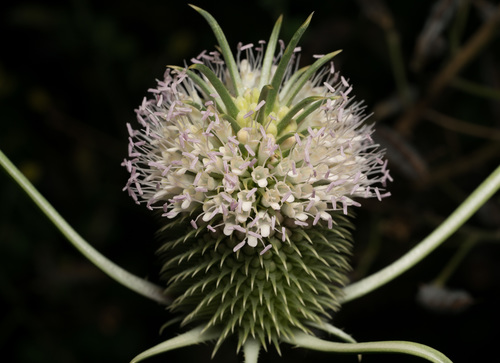
Fuller's Teasel (Dipsacus sativus) is an extraordinary biennial plant famed for its unique historical role in the textile industry. Originally native to Eurasia, this stately wildflower stands tall with prickly stems and distinct cylindrical flower heads covered in stiff, recurved spines. Unlike its wild relative, Fuller's Teasel was intentionally cultivated for these hooked bracts, which were used for centuries to brush and raise the nap on woolen fabrics—a process known as fulling. Today, it persists as an escapee in disturbed sites, old fields, and along roadsides, carrying a rich history in its spiky silhouette. Beyond its utility to humans, the plant serves as an intriguing ecological subject. Its opposing leaves fuse together at the stem to form deep cups that collect rainwater, trapping insects and sparking scientific debate over whether it is a protocarnivorous species. It remains a fascinating blend of historical agriculture and botanical wonder.
生息地: Found in disturbed soils, old pastures, roadsides, and abandoned fields, often near historical textile mill sites.
This robust, prickly biennial can grow up to 2 meters tall. Its most identifying feature is the dense, egg-shaped to cylindrical flower head, which is densely packed with pale purple or pinkish-white blossoms that bloom in a ring. Surrounding these heads are stiff, downward-hooked bracts that curve backward, distinguishing it from wild teasel. The stems are deeply ridged and covered in sharp prickles. Its large, lance-shaped leaves are sessile and grow opposite each other, fusing at the stem base to create prominent water-collecting cups.
カテゴリ
植物レア度
Common
危険度
1/5 · 非常に低い
スナップ
最初にスナップしよう!
In the 19th century, millions of teasels were grown annually in Oregon and New York to supply the American textile industry.
Metal machines designed to replace teasels often tore the wool, so natural teasel heads remained the preferred tool for raising fabric nap for centuries.
The water-retaining leaf cups can trap and drown insects, prompting ongoing research into whether the plant is protocarnivorous.
The stiff bracts on the seed heads curve backwards to form hooks, an adaptation historically exploited by humans to tease wool and currently aiding in animal-mediated seed dispersal.
Opposite leaves fuse around the stem to form deep basins that collect water, potentially preventing crawling insects from stealing nectar or absorbing nutrients from trapped bugs.
Stems, leaves, and flower heads are heavily armed with sharp prickles that deter large herbivores from feeding on the plant.
As a photoautotrophic plant, Fuller's Teasel synthesizes its own food using sunlight, carbon dioxide, water, and essential soil nutrients.
Bombus terrestris
Visits the pinkish-purple flowers for nectar and acts as a major pollinator.
Aphis fabae
Feeds on the sap of the young stems and leaves, potentially weakening the plant.
Carduelis carduelis
Feeds on the seeds trapped within the spiny flower heads during late autumn and winter.
このオブジェクトにはまだ特徴バッジが割り当てられていません。
まだ別名はありません。
テーマが追加されると、このオブジェクトのコレクションがここに表示されます。
危険度
1/5 · 非常に低い
まだ特別な安全上の注意はありません。
Fuller'S Teaselを識別する最も簡単な方法は、Snappit自然識別アプリを使用することです。
100-200 cm
2 年
As a photoautotrophic plant, Fuller's Teasel synthesizes its own food using sunlight, carbon dioxide, water, and essential soil nutrients.
Found in disturbed soils, old pastures, roadsides, and abandoned fields, often near historical textile mill sites.
ズームインしてクラスターを分割し、このオブジェクトが撮影された場所を探索しましょう。
新しい観察が追加されると、ここに最近のスナップが表示されます。