

Georgia Tickseed
coreopsis nudata
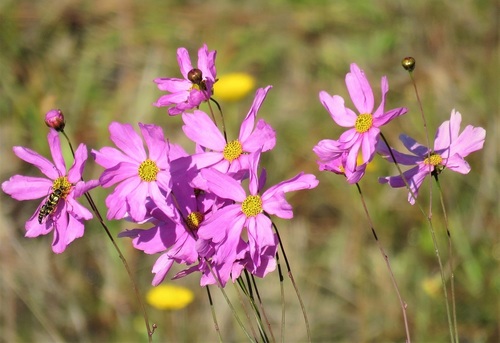
The Georgia Tickseed (Coreopsis nudata) is an exquisite and rare perennial wildflower native to the wetlands of the southeastern United States. While most species in the Coreopsis genus are famous for their brilliant yellow petals, this remarkable plant stands out with its beautiful pink to lavender-purple blossoms encircling a bright yellow central disk. Rising elegantly on slender, rush-like stems, it brings a splash of delicate pastel color to the acidic, waterlogged soils of pine savannas and bogs. Its unique morphology, including almost completely leafless stems, helps it survive and stand out in crowded wetland ecosystems.
生息地: Found in wet pine savannas, acidic bogs, flatwoods, and roadside ditches of the southeastern United States coastal plain.
Georgia Tickseed features striking daisy-like flower heads measuring about 5 to 7 centimeters across, with pale pink to lavender-purple ray florets surrounding a golden-yellow center. The plant grows on tall, wiry, dark green stems that are mostly naked and rush-like, with only a few tiny, inconspicuous leaves near the base. It can grow up to 120 centimeters tall, swaying gently above surrounding grasses and sedges in its boggy habitats.
カテゴリ
植物レア度
Common
危険度
1/5 · 非常に低い
スナップ
最初にスナップしよう!
Its seeds are small, flattened, and curved, resembling tiny ticks, which is how the genus Coreopsis earned the common name 'Tickseed'.
The species name 'nudata' translates to 'naked' in Latin, referring to its distinctive lack of leaves along the tall stem.
Unlike almost all other Coreopsis species, which are bright yellow, the Georgia Tickseed uniquely blooms in shades of pink and lavender.
It possesses rush-like, virtually leafless stems that contain chlorophyll, allowing the plant to perform photosynthesis directly through its stem to maximize energy production in boggy environments.
The roots are specially adapted to survive in waterlogged, anaerobic soils where typical plants would suffer from root rot due to a lack of oxygen.
Its flowers feature invisible ultraviolet patterns that direct bees and butterflies straight to the nectar-rich yellow center.
As a photosynthetic plant, the Georgia Tickseed manufactures its own food using sunlight, carbon dioxide, and water, supplemented by nutrients absorbed from acidic bog soils.
Bombus pensylvanicus
Pollinated by native bumblebees searching for nectar and pollen during the spring bloom.
Spinus tristis
The seeds are harvested and eaten by small granivorous wetland birds in late summer.
Sarracenia minor
Competes for sunlight and acidic soil space in marshy microhabitats.
このオブジェクトにはまだ特徴バッジが割り当てられていません。
まだ別名はありません。
テーマが追加されると、このオブジェクトのコレクションがここに表示されます。
危険度
1/5 · 非常に低い
まだ特別な安全上の注意はありません。
Georgia Tickseedを識別する最も簡単な方法は、Snappit自然識別アプリを使用することです。
60-120 cm
3-8 年
As a photosynthetic plant, the Georgia Tickseed manufactures its own food using sunlight, carbon dioxide, and water, supplemented by nutrients absorbed from acidic bog soils.
Found in wet pine savannas, acidic bogs, flatwoods, and roadside ditches of the southeastern United States coastal plain.
Photosynthesis
14-30 日
ズームインしてクラスターを分割し、このオブジェクトが撮影された場所を探索しましょう。
新しい観察が追加されると、ここに最近のスナップが表示されます。











