

Golden Reishi
ganoderma curtisii
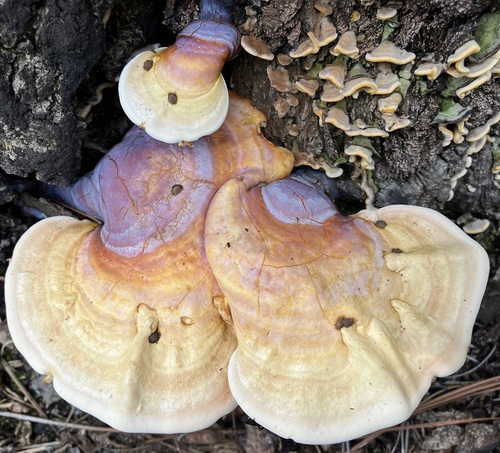
The Golden Reishi (Ganoderma curtisii) is a stunning, lacquer-capped polypore mushroom native to the deciduous forests of the eastern United States. Adorning the bases of decaying hardwood trees, especially oaks, this species is highly valued for both its ecological role and its resemblance to the legendary medicinal Reishi mushroom of East Asia. This fungus acts as a powerful saprotroph, recycling nutrients by breaking down stubborn wood components like lignin and cellulose, ensuring the forest floor remains fertile. Beyond its ecological importance, the Golden Reishi is a visual marvel. Its cap features a brilliant, varnished sheen that ranges from bright golden-yellow to rich reddish-brown, often offset by a clean, white growing margin. Hikers and foragers often spot it emerging in the warm, humid months of summer and autumn. While tough and woody—making it unpalatable for culinary use—it is frequently sought after for traditional herbal teas and extracts, carrying on a long cultural legacy of using Ganoderma species for health and wellness.
生息地: Found in temperate deciduous forests, typically growing at the base of living oak trees or on decaying hardwood stumps and logs.
The Golden Reishi is easily identified by its fan-shaped or kidney-shaped cap, which measures 4 to 15 centimeters in diameter and is covered in a glossy, resinous lacquer. The color transitions beautifully from a bright yellow or cream edge when actively growing, to a deep golden-yellow, orange, or reddish-brown center. Unlike some flat shelf fungi, it often possesses a distinct, varnished, lateral stalk that is dusty-brown to reddish-brown. The underside of the cap features a creamy-white pore surface that bruises brown when touched, lacking the traditional gills of typical mushrooms.
カテゴリ
菌類レア度
Common
危険度
1/5 · 非常に低い
スナップ
最初にスナップしよう!
Instead of gills like typical mushrooms, it has thousands of microscopic pores on its underside, which release a fine brown spore dust.
Its species name 'curtisii' honors Moses Ashley Curtis, an American botanist who extensively studied fungi in the southeastern US during the 19th century.
The shiny, lacquer-like coating on the cap is composed of complex resins that can actually melt slightly if exposed to high, direct heat.
While closely related to the true Asian Reishi (Ganoderma lingzhi), the Golden Reishi is a distinct species native to North America.
Produces specialized enzymes, including laccases, that break down complex lignin and cellulose structures within tough hardwood.
Secretes a shiny, lacquered crust over its cap that prevents dehydration and shields the delicate spore-producing tissues from heavy rain.
Discharges billions of microscopic, double-walled brown spores from its under-cap pores to colonize new substrates over vast distances.
As a saprotrophic fungus, it absorbs nutrients by decomposing dead and decaying hardwood trees, particularly oak species.
Quercus alba
Provides a decaying wood substrate for colonization by decomposing white-rot fungi and serves as a host substrate.
Mycetophila fungorum
The fruiting bodies provide food and a breeding ground for fungus gnat larvae.
このオブジェクトにはまだ特徴バッジが割り当てられていません。
まだ別名はありません。
テーマが追加されると、このオブジェクトのコレクションがここに表示されます。
危険度
1/5 · 非常に低い
まだ特別な安全上の注意はありません。
Golden Reishiを識別する最も簡単な方法は、Snappit自然識別アプリを使用することです。
4-15 cm
0.05-0.4 kg
1-5 年
As a saprotrophic fungus, it absorbs nutrients by decomposing dead and decaying hardwood trees, particularly oak species.
Found in temperate deciduous forests, typically growing at the base of living oak trees or on decaying hardwood stumps and logs.
Absorption
ズームインしてクラスターを分割し、このオブジェクトが撮影された場所を探索しましょう。
新しい観察が追加されると、ここに最近のスナップが表示されます。
















