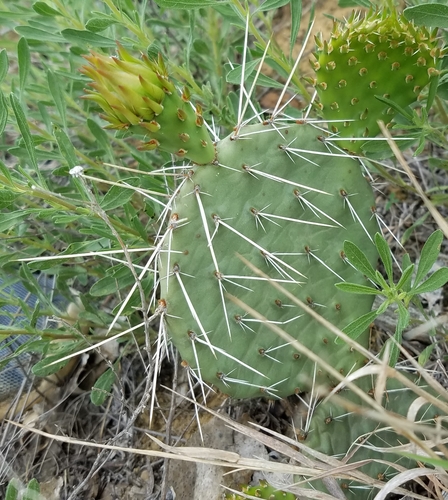


Grassland Pricklypear
opuntia cymochila
The Grassland Pricklypear, Opuntia cymochila, is a resilient and distinctive cactus species native to the arid and semi-arid grasslands of North America. Known for its segmented, paddle-shaped stems (pads) and vibrant flowers, it plays a vital ecological role in its harsh environment. This low-growing, sprawling plant is a master of water conservation, thriving in conditions where other flora struggle. Its succulent pads not only store precious water but also serve as a crucial food source for various wildlife, particularly during lean seasons. Beyond its ecological importance, the Grassland Pricklypear adds a touch of rugged beauty to the landscape, especially when its bright yellow blossoms unfurl, transforming the often-monotonous prairie into a vibrant spectacle.
生息地: Found in dry grasslands, prairies, open woodlands, and rocky slopes, often in sandy or gravelly well-drained soils.
Opuntia cymochila typically forms low, spreading mats of flattened, succulent pads, which are usually oblong to obovate in shape and can be light to dark green, sometimes with purplish tinges in stress. Each pad is armed with clusters of sharp spines, often yellowish or brownish, and tiny, barbed glochids that easily detach. Bright yellow, cup-shaped flowers, approximately 4-6 cm in diameter, emerge from the edges of the pads, usually in late spring to early summer. These flowers mature into reddish-purple, barrel-shaped fruits, commonly known as "tunas," which contain numerous seeds.
カテゴリ
植物レア度
Common
危険度
1/5 · 非常に低い
スナップ
最初にスナップしよう!
Despite their formidable spines, several animals, from peccaries to tortoises, consume prickly pear pads and fruits, often carefully.
The fruits of many Opuntia species, including O. cymochila, are edible and nutritious, often called "tunas."
The pads, also known as nopales, can be cooked and eaten as a vegetable, a staple in some regional cuisines.
The tiny, hair-like glochids found on prickly pears are more irritating than the large spines and can be very difficult to remove from skin.
Its thick, succulent pads are highly adapted for storing large quantities of water, allowing the plant to survive extended periods of drought in arid environments.
Utilizes Crassulacean Acid Metabolism, a photosynthetic pathway that minimizes water loss by opening stomata only at night to absorb carbon dioxide, significantly enhancing water use efficiency.
Pads can easily break off from the main plant and, if they land on suitable ground, can root and grow into entirely new individuals, enabling effective clonal reproduction and spread.
As an autotrophic plant, Opuntia cymochila produces its own food through photosynthesis, converting sunlight, carbon dioxide from the atmosphere, and water absorbed from the soil into sugars for energy and growth.
Apis mellifera
Pollinates flowers
Odocoileus virginianus
Consumes pads and fruit
Sylvilagus floridanus
Consumes pads and fruit
Campylorhynchus brunneicapillus
Consumes flowers and fruit, aids in seed dispersal
このオブジェクトにはまだ特徴バッジが割り当てられていません。
まだ別名はありません。
テーマが追加されると、このオブジェクトのコレクションがここに表示されます。
危険度
1/5 · 非常に低い
まだ特別な安全上の注意はありません。
Grassland Pricklypearを識別する最も簡単な方法は、Snappit自然識別アプリを使用することです。
10-30 cm
0.5-5 kg
10-30 年
As an autotrophic plant, Opuntia cymochila produces its own food through photosynthesis, converting sunlight, carbon dioxide from the atmosphere, and water absorbed from the soil into sugars for energy and growth.
Found in dry grasslands, prairies, open woodlands, and rocky slopes, often in sandy or gravelly well-drained soils.
ズームインしてクラスターを分割し、このオブジェクトが撮影された場所を探索しましょう。
新しい観察が追加されると、ここに最近のスナップが表示されます。









_-_Parc_Natural_de_s%27Albufera%2C_Spain_2022-04-18_(02).jpg&width=800)