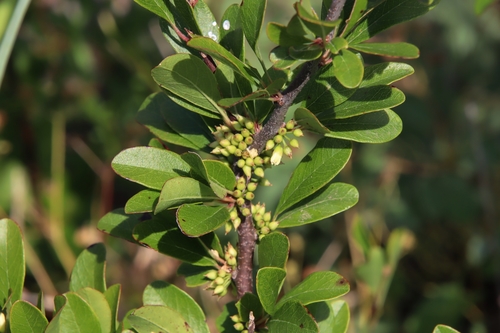


Gum Bumelia
sideroxylon lanuginosum
Gum Bumelia, scientifically known as Sideroxylon lanuginosum, is a resilient, thorny shrub or small tree native to the southern United States and northern Mexico. Often referred to as chittamwood or woollybucket buckthorn, this species is highly regarded for its toughness and ability to thrive in harsh, dry environments. It typically grows in rocky or sandy soils, establishing a deep root system that helps it withstand prolonged periods of drought. Historically, various Native American tribes utilized its sticky latex sap as an early form of chewing gum, and its dense, heavy wood was favored for creating durable tool handles. In late summer, the tree produces clusters of tiny, bell-shaped, cream-colored flowers that emit a sweet fragrance, attracting a wide variety of native pollinators. These flowers eventually give way to small, glossy, blue-black berries that serve as a critical food source for migrating birds and local mammals during the autumn months. Its rugged appearance and ecological utility make it a fascinating specimen of arid and semi-arid woodland ecosystems.
生息地: Found in dry, sandy or rocky soils of open woodlands, glades, prairies, and riparian edges.
Gum Bumelia typically presents as a multi-trunked shrub or small tree reaching heights between 3 and 15 meters, characterized by a rounded, spreading crown and irregular, thorny branches. Its leaves are simple, alternate, and often clustered on short spur branches; they are oblong to obovate, measuring 3 to 8 centimeters long. The upper surface of the leaves is a lustrous dark green, while the undersides are coated in a distinctive dense, woolly layer of rusty-brown or silvery hairs. In late summer, clusters of small, fragrant white-to-greenish flowers bloom in leaf axils, followed in autumn by dark blue-black, egg-shaped drupes about 1 centimeter in length.
カテゴリ
植物レア度
Common
危険度
1/5 · 非常に低い
スナップ
最初にスナップしよう!
Despite its relatively small size, the wood of this tree is remarkably heavy, hard, and close-grained, which made it popular for crafting durable tool handles.
Its species name 'lanuginosum' is Latin for 'woolly,' directly referencing the soft, felt-like hairs covering the undersides of its leaves.
The common name 'Gum Bumelia' comes from the sticky, elastic latex sap that flows from wounded bark, which children and indigenous peoples historically chewed like gum.
The dense layer of woolly hairs (trichomes) on the undersides of its leaves reduces water loss from transpiration and reflects intense sunlight.
Modified branch tips form sharp thorns that deter large herbivorous mammals from browsing on its foliage.
Produces a thick, milky latex sap when bark or leaves are damaged, sealing wounds against pests and fungal pathogens.
As an autotrophic plant, it produces its own energy via photosynthesis using sunlight, water, and carbon dioxide while extracting vital minerals from the soil.
Callophrys henrici
Caterpillars of this butterfly species feed on the foliage of Gum Bumelia as their primary larval host plant.
Bombycilla cedrorum
Feeds heavily on the ripe, dark blue-black berries during its autumn migration.
Odocoileus virginianus
Browses on the leaves and tender young twigs, especially in areas with limited forage.
このオブジェクトにはまだ特徴バッジが割り当てられていません。
まだ別名はありません。
テーマが追加されると、このオブジェクトのコレクションがここに表示されます。
危険度
1/5 · 非常に低い
まだ特別な安全上の注意はありません。
Gum Bumeliaを識別する最も簡単な方法は、Snappit自然識別アプリを使用することです。
300-1500 cm
50-150 年
As an autotrophic plant, it produces its own energy via photosynthesis using sunlight, water, and carbon dioxide while extracting vital minerals from the soil.
Found in dry, sandy or rocky soils of open woodlands, glades, prairies, and riparian edges.
ズームインしてクラスターを分割し、このオブジェクトが撮影された場所を探索しましょう。
新しい観察が追加されると、ここに最近のスナップが表示されます。




















