

Gyponana
gyponana
Members of the genus Gyponana, commonly known as green leafhoppers, are fascinating and abundant insects within the family Cicadellidae. These small, wedge-shaped creatures are highly adapted to life among foliage, where they spend their days feeding on plant sap. Characterized by their pale green coloration, which provides excellent camouflage against leaves, they are a common sight in gardens, forests, and fields across North America. Despite their small size, Gyponana leafhoppers play a significant role in their ecosystems, acting as both consumers of plant juices and vital food sources for various predatory insects, birds, and spiders. Their remarkable jumping ability and complex vibrational communication methods make them a marvel of evolutionary adaptation, captivating entomologists and backyard nature observers alike.
生息地: Typically found in temperate forests, shrublands, and domestic gardens, where they rest on the undersides of leaves of various deciduous trees and herbaceous plants.
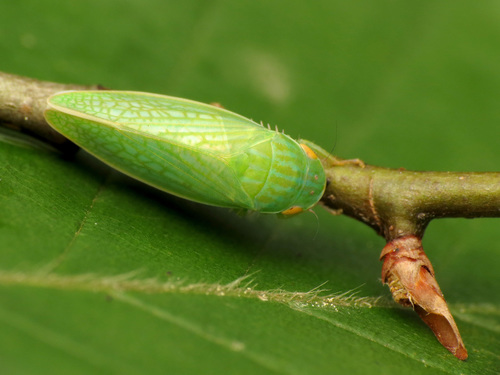
Gyponana leafhoppers are characterized by their elongated, wedge-shaped bodies, typically measuring between 1 to 2 centimeters in length. They are primarily pale green to yellowish-green, allowing them to blend seamlessly with host leaves. Their broad, flat heads have small eyes that sometimes display a subtle reddish tint. Depending on the species, some individuals may feature faint, lengthwise orange or reddish stripes running down their pronotum. When at rest, their wings are held roof-like over their abdomen, forming a clean, aerodynamic silhouette.
カテゴリ
昆虫レア度
Common
危険度
1/5 · 非常に低い
スナップ
最初にスナップしよう!
The brochosome coating they secrete is so structurally unique that scientists are studying it to develop advanced anti-reflective and water-resistant materials.
They are sometimes called sharpshooters because they actively flick away droplets of waste fluid, known as honeydew, to avoid attracting predators.
They can jump up to 100 times their body length in a single leap, generating forces that would cause a human to black out.
These leafhoppers produce microscopic, hollow protein-lipid spheres called brochosomes, which they rub over their bodies to create a highly water-repellent and self-cleaning protective layer.
Using specialized hind legs equipped with a catapult mechanism, they can launch themselves into the air at incredible speeds to escape predators in milliseconds.
Rather than using airborne sounds like cicadas, they communicate with potential mates by sending low-frequency vibrations through the stems and leaves of their host plants.
Gyponana leafhoppers feed strictly on plant fluids, using their specialized piercing-sucking mouthparts to tap into the vascular systems of host plants.
年齢による違い: Nymphs and adults feed on the same plant fluids, though nymphs target younger, softer plant tissue.
Quercus alba
Feeds on the leaves and sap of the host tree.
Chrysoperla carnea
Pours over foliage to hunt and consume leafhopper nymphs and adults.
Gonatopus ashmeadi
Infects and parasitizes leafhopper nymphs, eventually killing them.
このオブジェクトにはまだ特徴バッジが割り当てられていません。
まだ別名はありません。
テーマが追加されると、このオブジェクトのコレクションがここに表示されます。
危険度
1/5 · 非常に低い
まだ特別な安全上の注意はありません。
Gyponanaを識別する最も簡単な方法は、Snappit自然識別アプリを使用することです。
1-2 cm
1-2 cm
0.00001-0.00003 kg
1 年
Gyponana leafhoppers feed strictly on plant fluids, using their specialized piercing-sucking mouthparts to tap into the vascular systems of host plants.
Typically found in temperate forests, shrublands, and domestic gardens, where they rest on the undersides of leaves of various deciduous trees and herbaceous plants.
Grazing
ズームインしてクラスターを分割し、このオブジェクトが撮影された場所を探索しましょう。
新しい観察が追加されると、ここに最近のスナップが表示されます。