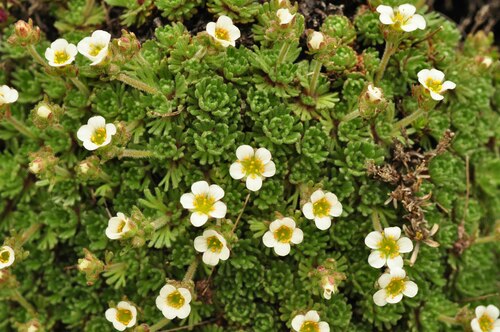


Hairy Saxifrage
saxifraga pubescens
Hairy Saxifrage (Saxifraga pubescens) is a resilient, hardy alpine perennial that thrives in the extreme, high-altitude crevices of European mountain ranges, particularly the Pyrenees. This beautiful plant forms dense, low-growing cushions of tiny, highly sticky, and hairy leaves, allowing it to withstand severe wind, cold, and intense solar radiation. In the late spring and early summer, these green, moss-like mats erupt with delicate white flowers, creating a striking contrast against the barren alpine rock. As a natural rock-dweller, it plays a vital role in stabilizing loose scree and preparing the soil for other pioneer species.
生息地: Typically found clinging to crevices in sheer limestone cliffs, rocky ledges, and high-altitude scree slopes in alpine zones.
Hairy Saxifrage grows in dense, compact cushions that typically reach 5 to 15 centimeters in height when in bloom. Its small, wedge-shaped leaves are deeply divided into lobes and are thickly covered in fine, sticky glandular hairs that give the plant a textured, grayish-green appearance. The flowers are carried on short, reddish-green upright stems and feature five rounded, pure-white petals, often decorated with delicate yellow-green veins near the base surrounding yellow anthers.
カテゴリ
植物レア度
Common
危険度
1/5 · 非常に低い
スナップ
最初にスナップしよう!
Hairy Saxifrage acts as a pioneer species; as its older leaves die inside the tight cushion, they decay and form a tiny pocket of rich soil that supports other mountain life.
The genus name 'Saxifraga' comes from the Latin words 'saxum' meaning rock and 'frangere' meaning to break, highlighting their ability to grow inside cracks and seemingly break stone.
The sticky, glandular hairs on their leaves function as a passive defense, trapping tiny herbivorous insects before they can bite into the foliage.
The dense layer of sticky glandular hairs acts as a micro-shield, reducing moisture loss from harsh alpine winds and insulating the leaves against freezing temperatures.
It develops a strong, deep, and fibrous root system capable of squeezing into microscopic cracks in solid rock to secure water and hold fast against snow slides.
By growing in tight, hemispherical domes, it minimizes its exposed surface area, trapping heat and creating a humid microclimate inside the cushion.
As a plant, Hairy Saxifrage generates its own energy through photosynthesis, converting sunlight, carbon dioxide, and water into sugars while absorbing trace minerals from rocky crevices.
Bombus pyrenaeus
Provides critical nectar and pollen to alpine bees during the short mountain summer.
Primula hirsuta
Competes for extremely scarce space, moisture, and soil nutrients in rock fissures.
Parnassius apollo
Larvae of this rare alpine butterfly feed on the succulent leaves of Saxifraga species.
このオブジェクトにはまだ特徴バッジが割り当てられていません。
まだ別名はありません。
テーマが追加されると、このオブジェクトのコレクションがここに表示されます。
危険度
1/5 · 非常に低い
まだ特別な安全上の注意はありません。
Hairy Saxifrageを識別する最も簡単な方法は、Snappit自然識別アプリを使用することです。
5-15 cm
0.01-0.05 kg
5-20 年
As a plant, Hairy Saxifrage generates its own energy through photosynthesis, converting sunlight, carbon dioxide, and water into sugars while absorbing trace minerals from rocky crevices.
Typically found clinging to crevices in sheer limestone cliffs, rocky ledges, and high-altitude scree slopes in alpine zones.
Photosynthesis
ズームインしてクラスターを分割し、このオブジェクトが撮影された場所を探索しましょう。
新しい観察が追加されると、ここに最近のスナップが表示されます。















