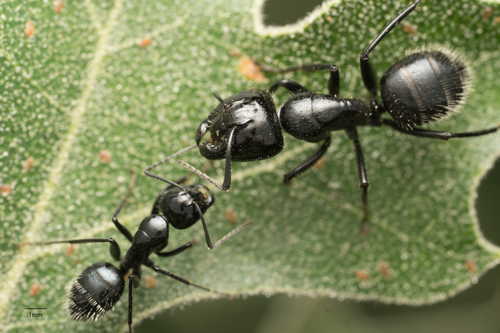


Hairy Smooth Carpenter Ant
camponotus laevissimus
The Hairy Smooth Carpenter Ant (Camponotus laevissimus) is a striking and robust insect native to the coniferous forests of western North America. As one of the largest ant species in its range, it plays a vital role in forest ecosystems by accelerating the decomposition of dead wood. Despite their intimidating size, these ants do not eat wood; instead, they excavate intricate galleries to house their complex, highly organized colonies. They are known for their shiny black bodies adorned with sparse, erect golden hairs, giving them a distinct textured appearance. Observing a colony in action reveals a sophisticated division of labor, with major workers defending the nest and minor workers foraging across the forest floor and up into the tree canopies.
生息地: Found in montane coniferous forests, nesting inside dead logs, stumps, and fallen trees, particularly Douglas-fir and pine.
This species is characterized by its large size, with workers ranging from 1 to 2 centimeters in length. They feature a highly polished, jet-black exoskeleton that reflects light, contrasted by a scattering of long, pale golden or yellowish hairs on their gaster and thorax. Their head is broad and heart-shaped, equipped with powerful mandibles capable of chewing through solid wood. Unlike some other carpenter ants, their thorax is evenly rounded in profile, and winged alates display dark, translucent wings that can span up to 3 centimeters.
カテゴリ
昆虫レア度
Common
危険度
1/5 · 非常に低い
スナップ
最初にスナップしよう!
A single colony of Camponotus laevissimus can grow to contain several thousand workers, all originating from a single founding queen.
During spring or early summer, winged males and queens leave the nest in massive synchronized nuptial flights to mate and establish new colonies.
They use chemical signals called pheromones to lay down precise foraging trails, allowing hundreds of workers to navigate to a rich food source.
Unlike termites, carpenter ants do not eat wood; they only excavate it to create spacious galleries for their growing colonies.
Using their exceptionally strong mandibles, they carve complex tunnels in decaying wood to build protective nests without actually consuming the timber.
They engage in mutualistic relationships with aphids, protecting them from predators in exchange for sweet, energy-rich honeydew.
When threatened, they can spray formic acid from the tip of their abdomen to deter predators and mark chemical alarm trails.
They primarily feed on honeydew secreted by aphids, plant sap, small insects, and scavenged organic matter.
年齢による違い: Larvae are fed a protein-rich diet of insect prey regurgitated by workers, while adults feed mostly on carbohydrate-rich honeydew and sap.
Cinara curvipes
Provides sugar-rich honeydew in exchange for protection from predators.
Dryocopus pileatus
Preys heavily upon carpenter ants by drilling into dead trees to consume them.
Pseudotsuga menziesii
Serves as the primary nesting host, where the ants excavate galleries in decaying wood.
このオブジェクトにはまだ特徴バッジが割り当てられていません。
まだ別名はありません。
テーマが追加されると、このオブジェクトのコレクションがここに表示されます。
危険度
1/5 · 非常に低い
まだ特別な安全上の注意はありません。
Hairy Smooth Carpenter Antを識別する最も簡単な方法は、Snappit自然識別アプリを使用することです。
1+ cm
1+ cm
0.00001+ kg
1+ 年
1 km/h
They primarily feed on honeydew secreted by aphids, plant sap, small insects, and scavenged organic matter.
Found in montane coniferous forests, nesting inside dead logs, stumps, and fallen trees, particularly Douglas-fir and pine.
ズームインしてクラスターを分割し、このオブジェクトが撮影された場所を探索しましょう。
新しい観察が追加されると、ここに最近のスナップが表示されます。












